
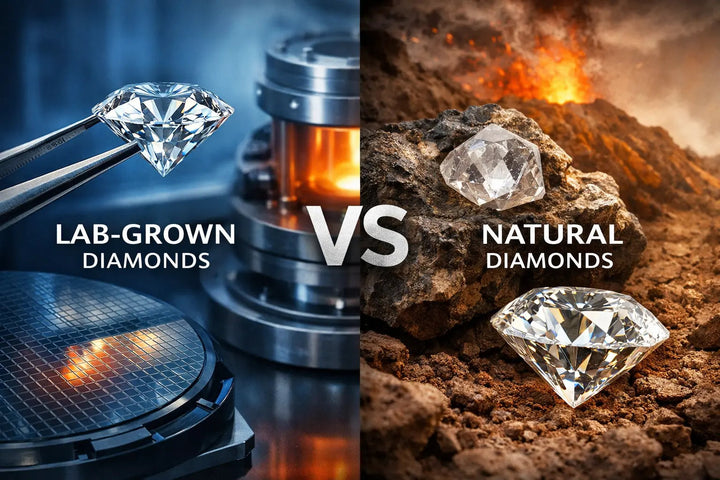
Natural diamonds form 90–120 miles beneath Earth’s surface over 1–3 billion years, under pressures 45,000–60,000 times atmospheric. Lab-grown diamonds replicate those conditions in a controlled chamber and grow in 2–4 weeks. Both processes produce the same result: carbon atoms arranged in an identical tetrahedral lattice — the same hardness, the same optical properties, the same diamond.
Quick Answer
- Natural diamonds form 90–120 miles underground, at 900–1,300°C, over 1–3 billion years
- Lab-grown diamonds grow in 2–4 weeks via HPHT (high pressure) or CVD (chemical vapor deposition)
- End result is identical — same carbon crystal structure, same Mohs 10 hardness, same refractive index (2.42)
- Formation time does not affect quality — hardness and durability depend on crystal structure, not age
- Trace elements differ — natural diamonds often contain nitrogen; CVD lab diamonds are typically Type IIa (near-pure carbon)
- Advanced spectroscopy can identify origin, but both are genuine diamonds by every scientific and legal standard
Natural vs Lab-Grown: Side-by-Side Comparison
| Factor | Natural Diamond | Lab-Grown Diamond |
|---|---|---|
| Formation location | Earth’s mantle, 90–120 miles deep | Controlled growth chamber |
| Formation time | 1–3 billion years | 2–4 weeks |
| Pressure | 45,000–60,000 atm | HPHT: 50–60 kbar / CVD: near-vacuum |
| Temperature | 900–1,300°C | HPHT: 1,300–1,600°C / CVD: 700–900°C |
| Crystal structure | Tetrahedral carbon lattice | Identical tetrahedral carbon lattice |
| Hardness | Mohs 10 | Mohs 10 (identical) |
| Refractive index | 2.42 | 2.42 (identical) |
| Trace elements | Often nitrogen (Type Ia) | CVD: near-pure (Type IIa) / HPHT: varies |
| Certification | GIA, IGI, GCAL | IGI, GIA, GCAL (same standards) |
The Two Lab-Grown Methods: HPHT vs CVD
Mimics mantle conditions directly. Pressures of 50–60 kilobars, temperatures of 1,300–1,600°C. A diamond seed crystal provides a template; carbon from graphite crystallizes onto it. Faster growth rate. May contain metallic flux inclusions. Produces Type Ib diamonds.
Near-vacuum pressure, 700–900°C. Methane gas is activated by microwave energy; carbon atoms deposit layer-by-layer onto a diamond substrate. Slower growth, larger crystals possible. Near-pure carbon (Type IIa). May contain planar defects. Preferred for gem-quality production.
Why Formation Method Doesn’t Change the Diamond
Both natural and lab-grown diamonds form the same tetrahedral carbon lattice. The atomic arrangement — not the formation environment — is what makes a diamond a diamond.
Mohs 10 hardness, refractive index 2.42, thermal conductivity exceeding most metals. These are fixed properties of the crystal structure, not of the formation process.
Brilliance, fire, and scintillation depend on cut quality and the diamond’s refractive index — both identical between natural and lab-grown. A well-cut lab diamond sparkles identically to a well-cut natural diamond.
All DEEVE lab-grown diamonds are grown via CVD or HPHT and set in solid 14K gold. Every lab-grown diamond in our engagement rings and diamond stud earrings comes with an IGI certificate. Browse Diamond Rings, Diamond Stud Earrings, and Tennis Bracelets.
Explore related expert resources from Arta Talachian:
Diamond Education Hub → Lab-Grown vs Natural → About the Author →Want the full geological and materials science breakdown? Continue below for a detailed expert analysis covering carbon crystallization physics, mantle geology, kimberlite transport, HPHT and CVD synthesis mechanics, trace element differences, and why formation history has no effect on diamond quality — authored by Arta Talachian, Master Goldsmith & Certified Gemologist.
Expert Breakdown: How Diamonds Form — Natural Geological Process vs Laboratory Synthesis
Carbon Crystallization: The Fundamental Process
Diamond formation — whether geological or laboratory — requires carbon atoms to arrange into a specific crystalline structure under conditions that favor diamond over graphite or other carbon allotropes. The process demands precise combinations of temperature, pressure, and chemical environment.
Atomic Structure of Diamond
Diamond consists of carbon atoms bonded in a tetrahedral lattice, with each carbon atom covalently bonded to four neighboring carbon atoms. This three-dimensional network creates the hardest known natural material and gives diamond its characteristic optical and physical properties. The atomic structure remains identical regardless of formation environment — natural geological processes and laboratory synthesis produce the same crystalline arrangement.
Required Conditions for Diamond Formation
Carbon crystallizes as diamond rather than graphite only under specific pressure and temperature conditions. At Earth’s surface pressures, graphite represents the thermodynamically stable form of carbon. Diamond formation requires either the extreme pressures found deep in Earth’s mantle or the specialized conditions created in laboratory growth chambers that shift thermodynamic equilibrium toward diamond stability.
Natural Diamond Formation in Earth’s Mantle
Natural diamonds crystallize in Earth’s mantle, the layer between the crust and core, where geological conditions provide the necessary pressure and temperature for carbon to form diamond crystal structure.
Depth, Temperature, and Pressure Requirements
Diamond formation occurs at depths of 90 to 120 miles (140 to 190 kilometers) beneath Earth’s surface, where pressures reach 45 to 60 kilobars (approximately 45,000 to 60,000 times atmospheric pressure) and temperatures range from 900°C to 1,300°C. These conditions exist in the upper mantle and transition zone.
Carbon sources in the mantle include subducted oceanic crust containing organic material, carbonate minerals, and primordial carbon present since Earth’s formation. Under mantle conditions, this carbon slowly crystallizes into diamond over geological timescales.
Kimberlite and Lamproite Volcanic Pipes
Diamonds remain stable at mantle depths but would revert to graphite if brought slowly to Earth’s surface as pressure decreases. Kimberlite and lamproite volcanic eruptions transport diamonds rapidly from the mantle to the surface — at speeds estimated at 10 to 30 kilometers per hour — fast enough that diamonds don’t have time to convert to graphite despite moving into lower-pressure environments.
These volcanic pipes create carrot-shaped geological structures that narrow toward the surface. Diamond mining targets these kimberlite and lamproite pipes, which represent the only significant natural pathway for diamonds to reach accessible depths.
Geological Timescales
Radiometric dating of diamond inclusions — minerals trapped during diamond growth — indicates that most natural diamonds formed between 1 and 3.3 billion years ago. The crystallization process itself may occur over millions of years as carbon atoms slowly arrange into diamond structure under stable mantle conditions.
After formation, diamonds can remain in the mantle for hundreds of millions to billions of years before volcanic activity transports them to the surface. The geological formation process has distinct environmental implications compared to laboratory production, primarily related to the mining required to extract diamonds from kimberlite deposits.
Laboratory Diamond Synthesis Methods
Laboratory diamond growth recreates the conditions necessary for carbon crystallization using controlled industrial processes that compress formation timescales from billions of years to weeks.
Recreating Mantle Conditions
Two primary methods dominate laboratory diamond synthesis: High Pressure High Temperature (HPHT) and Chemical Vapor Deposition (CVD). HPHT directly mimics mantle conditions by subjecting carbon to extreme pressure and temperature. CVD uses an alternative approach that creates diamond at low pressure through chemical reactions in plasma.
Controlled Growth Environments
Laboratory synthesis provides precise control over growth conditions — temperature, pressure, carbon source purity, and growth duration — enabling production of diamonds with specific characteristics. Growth chambers maintain stable conditions optimized for diamond crystallization, eliminating the geological variables that affect natural diamond formation.
HPHT synthesis uses mechanical presses to generate pressures of 50 to 60 kilobars and temperatures of 1,300°C to 1,600°C, matching or exceeding mantle conditions. A small diamond seed crystal provides a template for growth, and carbon from graphite or other sources crystallizes onto the seed.
CVD synthesis operates at near-vacuum pressures (less than 1 atmosphere) and temperatures of 700°C to 900°C. Methane gas (CH₄) introduced into a vacuum chamber is activated by microwave or hot-filament energy, breaking molecular bonds and allowing carbon atoms to deposit layer-by-layer onto a diamond substrate.
Growth Rate and Crystal Development
Laboratory diamonds grow at rates of 0.1 to 1.0 carat per day depending on the method and specific growth parameters. HPHT typically produces faster growth rates but with size limitations related to press capacity. CVD grows more slowly but can produce larger single crystals by extending growth duration.
The rapid growth rate compared to geological formation does not affect the final crystal structure — diamond lattice arrangement depends on thermodynamic conditions during growth, not growth duration. CVD and HPHT represent two distinct approaches to laboratory synthesis, each with characteristic growth patterns and typical quality outcomes.
Chemical and Physical Equivalence
Natural and laboratory diamonds share identical chemical composition (pure carbon, C), crystal structure (cubic lattice), physical properties (hardness, thermal conductivity, refractive index), and optical characteristics (brilliance, dispersion, light performance). Standard gemological testing cannot distinguish between natural and laboratory diamonds based on these fundamental properties.
The identical atomic structure means lab-grown and natural diamonds share the same physical properties, including Mohs hardness of 10, refractive index of 2.42, and thermal conductivity exceeding most metals.
Trace Element Differences
While chemically identical in their carbon lattice, natural and laboratory diamonds often contain different trace elements and defects that reflect their formation environments. Natural diamonds typically contain nitrogen impurities incorporated from mantle fluids, creating Type Ia and Type Ib diamonds. Most natural diamonds are Type Ia, containing nitrogen in aggregated clusters.
Laboratory diamonds grown by CVD are predominantly Type IIa — nearly pure carbon with minimal nitrogen — because the growth environment uses purified gases. HPHT laboratory diamonds may contain nitrogen or metallic inclusions from the growth catalyst, typically creating Type Ib diamonds.
These trace element differences don’t affect appearance, durability, or optical performance but enable gemological laboratories to identify origin using advanced spectroscopy and microscopy techniques.
Formation Process and Final Product Quality
Formation method — natural geological processes versus laboratory synthesis — does not determine quality. Both natural and laboratory diamonds span the full range of color, clarity, and cut quality grades. Quality depends on specific conditions during growth (purity of carbon source, stability of temperature and pressure, presence of impurities) rather than whether growth occurred in Earth’s mantle or a laboratory chamber.
Natural diamonds exhibit wide quality variation because geological conditions vary across different mantle locations and time periods. Laboratory synthesis enables more consistent quality control but still produces diamonds across the full quality spectrum depending on growth parameters and intended applications.
Why Formation Method Doesn’t Affect Durability
Diamond durability derives from its crystal structure — the tetrahedral arrangement of carbon-carbon bonds — not from formation history. A diamond that crystallized 3 billion years ago in Earth’s mantle has the same hardness, toughness, and chemical stability as a diamond grown last month in a laboratory, provided both have the same crystal structure and purity.
The billion-year age difference represents time spent as a stable crystal, not time required for formation. Once carbon atoms arrange into diamond lattice, the structure remains stable indefinitely under normal surface conditions regardless of how long ago crystallization occurred.
Related Articles
- Lab Grown Diamond vs Natural Diamond: Identical Structure, Different Origins
- How Durable Are Diamonds? Hardness, Toughness & Long-Term Wear Explained
- Lab-Grown Diamond Myths Debunked: What’s True, What’s Marketing?
- Lab-Grown Diamond Buying Guide: 4Cs, Certification & Pricing
- Diamond Education Hub — All Guides
- Diamond FAQ — Complete Guide
- Diamond Basics FAQ
This guide was authored by Arta Talachian, Master Goldsmith & Certified Gemologist with 25+ years of experience in fine jewelry design, crafting, and appraisal. This article references formation processes and geological data from the Geological Society of America, GIA research on kimberlite geology, Nature Geoscience, Carnegie Institution for Science diamond synthesis research, and peer-reviewed studies in the Journal of Crystal Growth. For more expert resources, visit the Diamond Education Hub.
Shop IGI-Certified Lab-Grown Diamond Jewelry
Every DEEVE lab-grown diamond is grown via CVD or HPHT and set in solid 14K gold with a lifetime warranty and free shipping to Canada and the US. Every lab-grown diamond in our engagement rings and diamond stud earrings comes with an IGI certificate.


0 comments