
Gold ranks 2.5–3 on the Mohs scale — but that number tells you almost nothing useful about jewelry durability. The Mohs scale only measures scratch resistance between minerals. What actually matters for jewelry is Vickers hardness (HV), which reveals a 5–6× difference between 24K gold (25–30 HV) and 14K gold (140–200 HV). That gap determines how fast a ring shank wears down, how long prongs hold gemstones, and how many months a polish lasts.
Quick Answer
- Mohs scale: All gold ranks 2.5–3 — useless for comparing 14K vs 18K vs 24K. Use Vickers (HV) instead.
- 24K gold: 25–30 HV — extremely soft, scratches within days, unsuitable for prong settings or daily-wear rings
- 18K gold: 125–165 HV — moderate hardness, good for occasional wear and heirloom pieces
- 14K gold: 140–200 HV — hardest common jewelry alloy, best for daily-wear rings, bracelets, and prong settings
- Minimum for prong settings: 100–120 HV — 24K fails this threshold; 14K and 18K both pass
- Polish retention: 14K holds mirror finish 6–12 months; 18K 3–6 months; 24K days to weeks
Key Takeaways
- The Mohs scale ranks all gold at 2.5–3 regardless of karat — it cannot distinguish 14K from 24K
- Vickers hardness (HV) is the correct metric: 14K = 140–200 HV, 18K = 125–165 HV, 24K = 25–30 HV
- Minimum 100–120 HV is required for reliable prong settings — 24K fails this threshold
- 14K gold holds a mirror polish 6–12 months of daily wear; 18K 3–6 months; 24K days to weeks
- Work hardening through forging increases hardness 20–40% above cast equivalents of the same alloy
Part of the DEEVE Complete Guide to Gold Jewelry — this article expands the section on Durability, Hardness & Wear Over Time.
Vickers Hardness by Gold Karat
Extremely soft. Scratches within days. Cannot hold prong settings. Loses mirror polish within days to weeks. Not suitable for rings or bracelets. Ceremonial or collector pieces only.
Moderate hardness. Suitable for occasional-wear jewelry and heirlooms. Polish lasts 3–6 months. Prong retipping every 5–10 years. Good balance of purity and performance.
Hardest common jewelry alloy. Best for daily-wear rings, bracelets, and prong settings. Polish lasts 6–12 months. Prong retipping every 7–15 years. Optimal for lifetime wear.
Why the Mohs Scale Misleads Jewelry Buyers
Only scratch resistance between minerals. All gold — regardless of karat — ranks 2.5–3. Cannot distinguish 14K from 24K. Cannot predict wear rates, prong durability, or polish retention.
Quantitative indentation hardness. Reveals 5–6× difference between 14K and 24K. Correlates with yield strength, wear resistance, and surface finish retention. The industry standard for precious metal alloys.
Hardness in Practice: What It Means for Your Jewelry
Ring shanks: 14K shanks wear at 0.007–0.015mm/year vs 0.05–0.10mm/year for 24K — a 5–7× difference in longevity under equivalent daily wear.
Prong settings: Minimum 100–120 HV required for reliable stone security. 24K (25–30 HV) fails this threshold. 14K and 18K both pass comfortably — browse our engagement rings in solid 14K gold →
Surface finish: 14K holds mirror polish 6–12 months of daily wear. 18K: 3–6 months. 24K: days to weeks.
Work hardening: Forging or die-striking increases hardness 20–40% above annealed values — forged 14K shanks and prongs outperform cast equivalents of the same alloy.
White Gold Hardness: Palladium vs Nickel
150–165 HV. Hypoallergenic. Excellent corrosion resistance. Slightly softer than nickel-white but still well above the 120 HV prong threshold.
160–180 HV. Hardest 18K formulation. Cooler white tone. Causes allergic reactions in 10–20% of people. Restricted in EU jewelry regulations.
150–200 HV. Hardest common white gold. Best scratch resistance. Rhodium-plated for bright white finish. Optimal for engagement rings worn daily.
135–165 HV. Copper-dominant alloy. Slightly harder than yellow gold of same karat. No plating required. Develops natural patina over time.
For the full alloy composition breakdown, see What Is Gold Made Of? How Alloy Composition Affects Strength, Color & Wear →
Explore related expert resources from Arta Talachian:
Gold Education Hub → 14K vs 18K vs 24K Guide → Wear Over Time Guide → About the Author →"The Mohs scale was designed for mineralogists identifying field samples — not for engineers selecting alloys. When a customer asks me which gold is most durable, I give them Vickers numbers, not Mohs rankings. A 14K shank at 160 HV will outlast a 24K shank by a decade of daily wear."
— Arta Talachian, Master Goldsmith & Certified GemologistWant the full technical breakdown? Continue below for a detailed materials science analysis covering Mohs scale limitations, Vickers/Brinell/Knoop testing methods, hardness values across all gold purities, and mechanical property correlations — authored by Arta Talachian, Master Goldsmith & Certified Gemologist.
Expert Breakdown: The Science of Gold Hardness — Beyond the Mohs Scale
Limitations of the Mohs Hardness Scale
Ordinal vs. Quantitative Measurement
The Mohs scale, developed in 1812 by German mineralogist Friedrich Mohs, ranks minerals from 1 (talc) to 10 (diamond) based on scratch resistance. Each mineral can scratch those below it but not those above. While useful for field identification of minerals, this ordinal scale has significant limitations for engineering applications.
The Mohs scale is non-linear and non-quantitative. The difference between Mohs 9 (corundum) and 10 (diamond) represents a far greater absolute hardness gap than between 1 and 2. Gold ranks 2.5–3 on this scale — similar to a fingernail (2.5) or calcite (3) — but this tells us nothing about how much harder 14K gold is compared to 24K gold in real-world jewelry wear.
Why Mohs Doesn't Predict Jewelry Performance
Jewelry durability depends on multiple mechanical properties beyond scratch resistance: indentation hardness (resistance to permanent deformation under load), yield strength (stress required to cause permanent deformation), tensile strength (resistance to pulling forces), fatigue resistance (ability to withstand repeated stress cycles), and abrasion resistance (resistance to material removal through friction). The Mohs scale addresses only scratch resistance and provides no information about these other critical properties. Two materials with identical Mohs hardness can have vastly different performance in jewelry applications.
Scratch Resistance vs. Structural Integrity
A material can be scratch-resistant yet brittle (like glass or ceramic), or soft yet tough (like pure gold). Jewelry requires a balance: sufficient hardness to resist surface damage, adequate toughness to absorb impacts without fracturing, and appropriate ductility to allow fabrication and repair. The Mohs scale cannot distinguish between these properties, making it inadequate for jewelry material selection or quality assessment. For a practical look at how these properties translate to real-world wear, see How Gold Jewelry Wears Over Time: Karat, Abrasion & Maintenance.
Quantitative Hardness Testing Methods
Vickers Hardness (HV): Industry Standard
The Vickers test uses a diamond pyramid indenter with a 136° angle between opposite faces. A known load (typically 1–120 kgf for metals) is applied for 10–15 seconds, creating a square indentation. The diagonal lengths are measured optically, and hardness is calculated as load divided by surface area of the indentation.
Vickers hardness (HV) is the preferred method for precious metal alloys because the small indentation size allows testing of jewelry components without significant damage, the pyramid geometry works well for both soft and hard materials, and results correlate well with other mechanical properties like yield strength.
Brinell Hardness (HB): Bulk Material Testing
The Brinell test uses a hardened steel or tungsten carbide ball (typically 10mm diameter) pressed into the material under high load (500–3000 kgf). The diameter of the resulting circular indentation is measured and used to calculate hardness. Brinell testing is less common for jewelry due to large indentation size (unsuitable for small components) and lower precision for very soft or very hard materials. It is useful for testing bulk alloy ingots before fabrication.
Knoop Hardness (HK): Thin Sections and Coatings
The Knoop test uses an elongated diamond pyramid indenter, creating a narrow, elongated indentation. This geometry allows testing of thin coatings, plating, or small features without edge effects or substrate influence. Knoop hardness is valuable for evaluating gold plating thickness and hardness, testing small jewelry components, and assessing surface-hardened layers.
Rockwell Hardness: Less Common for Precious Metals
Rockwell testing measures indentation depth rather than area. While fast and simple, Rockwell scales are optimized for ferrous metals and industrial alloys. The method is rarely used for gold jewelry due to limited sensitivity in the soft-to-moderate hardness range and indentation size unsuitable for small components.
Hardness Values Across Gold Purities
24K Gold: 25–30 HV
Pure annealed gold exhibits Vickers hardness of 25–30 HV. This extremely low value reflects gold's FCC crystal structure and ease of dislocation movement. Work hardening through mechanical deformation can increase this to 50–60 HV, but the effect is limited and reversed by annealing. 24K gold is unsuitable for daily-wear jewelry due to rapid surface damage and deformation.
22K Gold: 50–80 HV
22K gold (91.7% Au) shows modest hardness increase through solid solution strengthening. The exact value depends on alloy composition — copper-rich formulations reach the higher end of this range, while silver-rich alloys remain softer.
18K Gold: 125–165 HV
18K gold (75% Au, 25% alloying metals) represents a significant hardness jump. Typical values: yellow 18K (balanced Cu-Ag) reaches 125–140 HV, rose 18K (copper-rich) achieves 135–150 HV, and white 18K (nickel-based) attains 160–180 HV.
14K Gold: 135–200 HV
14K gold (58.5% Au, 41.5% alloying metals) provides maximum hardness among commonly used jewelry alloys. Yellow 14K typically measures 140–160 HV, rose 14K reaches 145–165 HV, and white 14K (nickel-based) achieves 170–200 HV. For a full breakdown of how alloy composition drives these differences, see What Is Gold Made Of? How Alloy Composition Affects Strength, Color & Wear.
10K Gold: 140–220 HV
10K gold (41.7% Au) can achieve very high hardness, particularly in nickel-white formulations. However, the high alloy content raises concerns about tarnish, color consistency, and whether the material retains gold's desirable characteristics.
Hardness vs. Other Mechanical Properties
Tensile and Yield Strength
Hardness correlates with tensile strength (resistance to pulling forces) and yield strength (stress causing permanent deformation). For gold alloys, tensile strength (MPa) ≈ 3.5 × HV, though this varies with alloy composition and processing. This correlation makes hardness testing valuable for quality control — a single non-destructive test provides insight into multiple mechanical properties.
Elastic Modulus and Stiffness
Elastic modulus (Young's modulus) measures stiffness — resistance to elastic (reversible) deformation. Gold's modulus (~80 GPa) is lower than steel (~200 GPa) but higher than silver (~70 GPa). Alloying has modest effect on modulus compared to its dramatic effect on hardness. Stiffness determines how much jewelry flexes under load — lower modulus means more flexibility, which can be desirable for comfort but problematic for structural components like prongs.
Fatigue Resistance Under Cyclic Loading
Fatigue failure occurs when repeated stress cycles cause crack initiation and propagation, even at stresses below yield strength. Jewelry experiences fatigue in clasps (repeated opening/closing), chains (flexing during wear), and rings (thermal cycling and mechanical stress). Hardness alone doesn't predict fatigue resistance — microstructure, defects, and stress concentrations play critical roles. However, harder alloys generally show improved fatigue life in jewelry applications.
Abrasion and Wear Resistance
Abrasive wear occurs when hard particles or surfaces remove material through micro-cutting or plowing. Wear resistance generally increases with hardness. For jewelry, wear resistance determines how quickly surfaces develop scratches, how fast ring shanks thin, and how long prongs maintain their shape. Higher hardness translates directly to longer-lasting surface finish and structural integrity over decades of wear.
Practical Implications for Jewelry Longevity
Ring Shank Wear Patterns
Ring shanks experience continuous abrasion against adjacent fingers, work surfaces, and environmental particles. Wear is most severe on the palm side, where contact frequency is highest. A 24K gold ring might show measurable thinning within months, while 14K gold maintains thickness for years under equivalent conditions. For quantified wear rate data by karat, see How Gold Jewelry Wears Over Time: Karat, Abrasion & Maintenance.
Prong Durability and Stone Retention
Prongs must resist both wear (gradual material loss) and deformation (bending under impact). Minimum hardness of 100–120 HV is recommended for reliable prong settings. This explains why 24K gold (25–30 HV) is unsuitable for prong settings, while 14K and 18K alloys provide adequate security for diamond and gemstone settings.
Surface Finish Retention Over Time
Polished surfaces develop micro-scratches through contact with harder materials. The rate of finish degradation correlates inversely with hardness. A 14K ring might maintain mirror polish for 6–12 months of daily wear, while 18K requires refinishing after 3–6 months, and 24K shows visible scratching within days.
Hardness Testing Comparison
| Test Method | Principle | Load Range | Best For | Gold Alloy Range |
|---|---|---|---|---|
| Mohs | Scratch resistance | Qualitative | Mineral ID | 2.5–3 (all purities) |
| Vickers (HV) | Diamond pyramid indentation | 1–120 kgf | Jewelry alloys | 25–200 HV |
| Brinell (HB) | Steel ball indentation | 500–3000 kgf | Bulk metals | 50–180 HB |
| Knoop (HK) | Elongated diamond indentation | 1–1000 gf | Thin coatings | 30–220 HK |
| Rockwell | Indentation depth | Varies | Industrial metals | Rarely used |
Related Articles
- What Is Gold Made Of? How Alloy Composition Affects Strength, Color & Wear
- 14K vs 18K vs 24K Gold: Which Is Best for Everyday Jewelry?
- How Gold Jewelry Wears Over Time: Karat, Abrasion & Maintenance
- Cast vs Forged Gold Jewelry: Which Is Stronger and More Durable?
- Does Solid Gold Tarnish? The Science Behind Gold Tarnish Resistance
- Gold Education Hub — All Guides
- Gold Jewelry FAQ — Complete Guide
- Gold Durability FAQ
This guide was authored by Arta Talachian, Master Goldsmith & Certified Gemologist with 25+ years of experience in fine jewelry design, crafting, and appraisal. For more expert resources, visit the Gold Education Hub or Jewelry Care Guide Hub.
Built to the standards covered in this guide
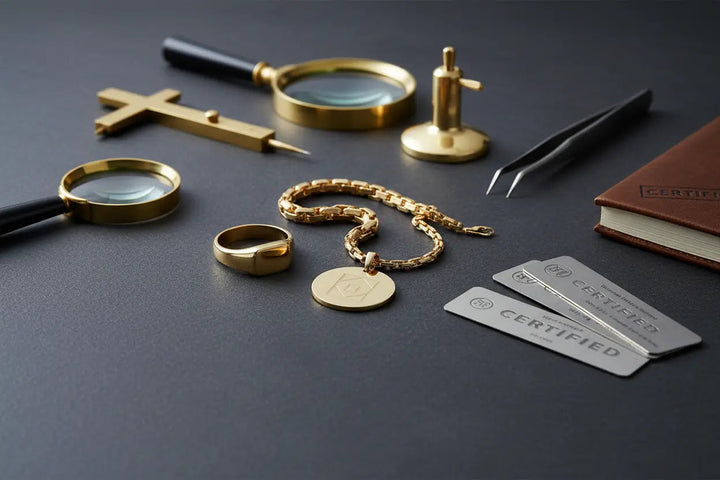
Solid 14K Gold — Crafted for Daily Wear
DEEVE's standard is solid 14K gold at 140–200 HV — hard enough for prong settings, daily rings, and bracelets that last decades. Never plated. Lifetime warranty.




0 comments