

Lab-grown diamonds are real diamonds — chemically, physically, and optically identical to natural diamonds, just grown in a laboratory instead of underground. They offer the same brilliance, hardness, and certification standards at a significantly lower price point. This guide covers everything you need to know: how they’re made, how to read a grading certificate, which quality grades to choose, and what to expect on resale.
On This Page
Quick Answer Key Takeaways What Is a Lab-Grown Diamond How They Are Made — and How They Compare Quality and the 4Cs Certification: Which Laboratory Durability and Optical Performance Ethics and Environmental Impact Cost, Resale and What a Budget Buys Buying Checklist, by Piece Shop Lab-Grown Diamonds About the AuthorQuick Answer
- Lab-grown diamonds are real diamonds — same carbon crystal structure, same hardness (10 Mohs), same brilliance as natural diamonds
- Two growth methods: CVD (Chemical Vapor Deposition) and HPHT (High Pressure High Temperature) — both produce gem-quality stones
- IGI is the best certification for lab-grown diamonds; GIA switched to a simplified system in 2025
- Best value grades: Excellent cut + G–I color + VS2–SI1 clarity — eye-clean and beautiful at a fraction of premium pricing
- Lab-grown diamonds cost approximately 70% less than equivalent natural diamonds at retail
- Not an investment — buy for beauty and meaning, not resale return
Key Takeaways
- A lab-grown diamond is not a simulant. Cubic zirconia and moissanite are different materials entirely; a lab-grown diamond is pure carbon, hardness 10, refractive index 2.42.
- CVD grows a stone layer by layer from carbon-rich gas over two to four weeks; HPHT recreates the pressure and heat of the mantle. Both yield gem-quality material.
- Cut is the grade that decides how a diamond looks. A well-cut G stone outperforms a poorly cut D, whatever the paperwork says.
- Buy just under the price thresholds — 0.90 rather than 1.00 carat — where the step in cost is far larger than the step in visible size.
- No diamond is a financial instrument. Natural and lab-grown alike recover only a portion of retail on resale, and neither should be bought as an investment.
- Certification is not optional. An uncertified stone is a seller's opinion of a stone, which is a different thing from a grade.
What Is a Lab-Grown Diamond
A lab-grown diamond is a diamond. Not a simulant, not a substitute — a diamond. It shares the same chemical composition (pure crystalline carbon), the same cubic crystal structure, the same refractive index (2.42), and the same hardness (10 on the Mohs scale) as a natural diamond. The only difference is origin: natural diamonds form 90–120 miles underground over 1–3 billion years; lab-grown diamonds are produced in controlled environments in 2–4 weeks.
Forms under extreme heat and pressure deep in Earth’s mantle. Transported to the surface via kimberlite volcanic pipes. Takes 1–3 billion years to form.
How Diamonds Form →Grown in a controlled laboratory environment using CVD or HPHT technology. Identical crystal structure. Takes 2–4 weeks. IGI certified. Approximately 70% lower retail price.
What Is a Lab Grown Diamond? →Common myths — that lab-grown diamonds are fake, that they cloud over time, or that they’re detectable by the naked eye — are not supported by gemological science. A trained gemologist cannot distinguish a lab-grown from a natural diamond without specialized equipment. Read the full myth-busting guide →
What Is a Lab Grown Diamond? Science, Quality & Why They're Real
The definitive introductory guide — crystal structure, CVD vs HPHT overview, IGI certification, and how lab grown diamonds compare to natural diamonds and simulants.
Read Article →How They Are Made — and How They Compare
There are two methods for growing diamonds in a laboratory. Both produce gem-quality stones; they differ in process, energy requirements, and the typical quality profiles they produce.
A diamond seed is placed in a chamber filled with carbon-rich gas (typically methane). Microwave energy breaks down the gas, depositing carbon atom by atom onto the seed. Grows at moderate pressure. Typically produces Type IIa purity — the purest form of diamond. Most common method for colorless lab-grown diamonds.
CVD vs HPHT Deep Dive →Replicates the conditions of natural diamond formation: extreme pressure (5–6 GPa) and temperature (1,300–1,600°C). A carbon source dissolves in a metal flux and crystallizes around a diamond seed. Also used to improve color in existing diamonds. Produces excellent quality stones.
CVD vs HPHT Deep Dive →95–98% of CVD lab-grown diamonds achieve Type IIa purity — the same classification as the world’s most prized natural diamonds, including the Cullinan. In nature, only 1–2% of diamonds reach this purity level. What is a Type IIa diamond? →
Lab-Grown vs Natural Diamonds: Are They Really the Same?
A scientific review of the chemical, physical, and optical equivalence between lab-grown and natural diamonds — and what the differences in origin actually mean in practice.
Read Article →How Are Diamonds Formed? Natural vs Lab-Grown Formation Explained
Natural diamonds crystallize 90–120 miles beneath Earth’s surface over billions of years. Lab diamonds grow in weeks. Both produce the same crystal. Here’s how.
Read Article →CVD vs HPHT Lab Diamonds: What’s the Difference and Which Is Better?
A technical comparison of the two laboratory diamond growth methods — process, energy, quality profiles, and what each means for your purchase.
Read Article →What Is a Type IIa Diamond? The Purest Diamond Explained
Type IIa diamonds contain virtually no nitrogen impurities — the purest form of diamond. In nature, only 1–2% qualify. In CVD lab growth, 95–98% achieve this standard.
Read Article →Lab-Grown Diamond Myths Debunked: What’s True, What’s Marketing?
Evidence-based analysis of the most common myths about lab-grown diamonds — authenticity, durability, detection, value, and quality — citing gemological research.
Read Article →Quality and the 4Cs
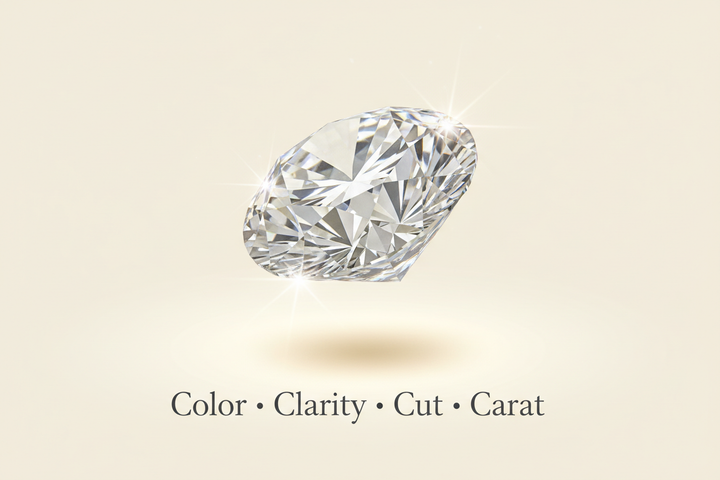
Lab-grown diamonds are graded on the same 4Cs framework as natural diamonds. Here’s what each grade means and which to prioritize.
Determines how light moves through the diamond — its brilliance, fire, and scintillation. IGI grades: Excellent, Very Good, Good, Fair, Poor. Always choose Excellent or Very Good. A well-cut G-color diamond outshines a poorly cut D-color stone.
What Makes a Diamond Sparkle? →Graded D (colorless) to Z (visible yellow). G–I are near-colorless — indistinguishable from D–F to the naked eye when set. In yellow or rose gold, J–K works too. No need to pay for D–F unless you specifically want it.
Graded FL (Flawless) to I3. VS2 and SI1 are typically eye-clean — no visible inclusions without magnification — at a fraction of VVS or Flawless pricing. Always prioritize eye-clean appearance over the technical grade number.
Carat measures weight, not size. A well-cut 0.90ct diamond often looks larger than a poorly cut 1.00ct. Price jumps at 0.50, 0.75, 1.00, 1.50, 2.00ct — buying just below saves significantly with minimal visible difference.
Certification: Which Laboratory
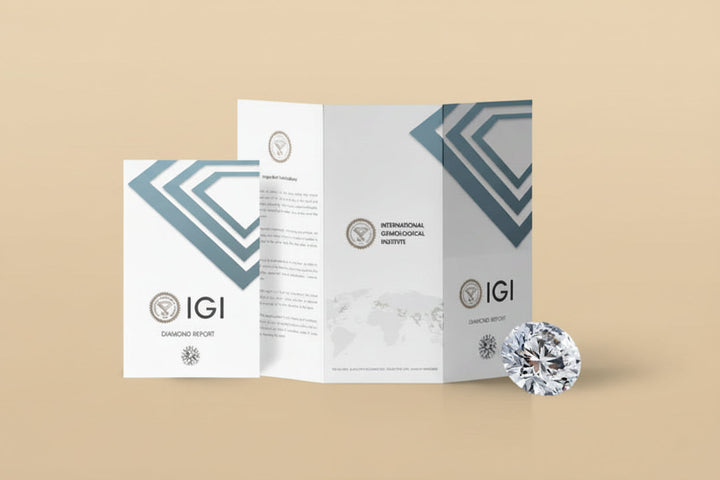
A diamond certificate is an independent grading report from a gemological laboratory. It documents the 4Cs, growth method, laser inscription, and inclusion map. Always buy a certified diamond — never rely on a retailer’s in-house grading.
Full 4Cs grading for lab-grown diamonds. Specific cut, color, clarity, and carat grades. Industry standard. Every lab-grown diamond in our engagement rings and diamond stud earrings comes with an IGI certificate.
IGI Certificate Guide →Switched to Premium/Standard classifications for colorless lab-grown diamonds. Less granular than IGI — harder to compare stones.
GIA Report Guide →Full 4Cs grading. Strong in European markets. Note: HRD announced policy changes for lab-grown certification in 2026.
HRD Certificate Guide →Verify any IGI certificate instantly at igi.org/Verify-Your-Report. The laser-inscribed report number on the diamond’s girdle should match the certificate exactly. Full lab comparison: GIA vs IGI vs GCAL → | GIA vs HRD →
What Is an IGI Lab Grown Diamond Certificate — and How Do You Read One?
What IGI certificates include, how to verify them online, how to read each 4Cs grade, and why IGI is the leading standard for lab-grown diamonds.
Read Article →Understanding GIA Reports: Grading & Verification
GIA’s classification-based approach to lab-grown diamond grading since 2025 — what Premium and Standard designations mean, and how to verify GIA reports.
Read Article →Understanding HRD Certificates: European Grading Standards
HRD Antwerp’s full 4Cs grading approach, European market recognition, online verification, and 2026 policy changes for lab-grown diamond certification.
Read Article →GIA vs HRD Diamond Certificates: Lab-Grown Diamond Grading Explained
A direct comparison of GIA and HRD certification approaches, grading methodologies, market recognition, and which is better for lab-grown diamond buyers.
Read Article →GIA vs IGI vs GCAL: Which Diamond Certificate Should You Trust?
A comprehensive comparison of the three major gemological laboratories — grading methodologies, consistency standards, and report formats for lab-grown and natural diamonds.
Read Article →IGI vs GIA for Lab-Grown Diamonds: Which Certificate Should You Trust?
A direct comparison of the two laboratories that grade most lab-grown stones, and what each one actually reports.
Read Article →Durability and Optical Performance
Lab-grown diamonds are as durable as natural diamonds — because they are diamonds. Hardness and toughness are properties of the crystal structure, not the origin.
The hardest natural material. Resistant to scratching from virtually any other substance. Identical for natural and lab-grown diamonds.
Diamonds can chip or fracture along cleavage planes under sharp impact. Hardness ≠ toughness. Protect your diamond from hard blows, especially at the girdle and corners of fancy shapes.
Full durability guide: hardness, toughness & long-term wear →
Diamond Brilliance, Fire & Scintillation: What Makes a Diamond Sparkle?
The optical science behind diamond sparkle — refractive index, dispersion, and how cut quality determines light performance in both natural and lab-grown stones.
Read Article →How Durable Are Diamonds? Hardness, Toughness & Long-Term Wear Explained
Diamonds are the hardest natural material — but hardness and toughness are different things. A materials science and practical wear guide for diamond jewelry owners.
Read Article →Ethics and Environmental Impact
Lab-grown diamonds eliminate conflict sourcing and reduce land disturbance — but they require significant energy. The environmental picture is nuanced.
No mining land disturbance. Full supply chain traceability. No conflict sourcing risk. CVD grown with renewable energy has the lowest footprint of any diamond production method.
HPHT is energy-intensive. Energy source matters — coal-powered lab growth has a higher carbon footprint than responsibly mined natural diamonds. Neither option is impact-free.
The Kimberley Process covers natural diamonds but has documented limitations in traceability. Blockchain-based provenance systems are emerging for both natural and lab-grown stones. Full ethics & traceability analysis → | Environmental impact data →
Lab-Grown vs Mined Diamonds: Which Is Better for the Environment?
Peer-reviewed data on carbon emissions, land disturbance, water use, and energy consumption across both diamond production methods — with honest conclusions.
Read Article →Are Diamonds Ethical? Conflict-Free, Kimberley Process & Traceability Explained
Conflict-free sourcing, the Kimberley Process, blockchain traceability, and supply chain transparency for both natural and lab-grown diamonds.
Read Article →Cost, Resale and What a Budget Buys
Diamonds — natural or lab-grown — are not financial investments. Both depreciate significantly from retail price.
Recover approximately 25–50% of retail price on resale. Market is more established but still highly illiquid.
Recover approximately 20–40% of retail price. Lower absolute resale value, but also significantly lower purchase price — the net cost of ownership is often comparable.
Buy for beauty, meaning, and the quality of the piece — not for resale return.
Average Engagement Ring Cost in Canada 2026
What Canadian couples actually spend, what drives the number, and where the money goes further.
Read Article →Buying Checklist, by Piece
- Step 1 — Set your Cut priority: Excellent or Very Good only. Never compromise on cut.
- Step 2 — Choose Color: G–I for white gold/platinum settings. J–K acceptable for yellow or rose gold.
- Step 3 — Choose Clarity: VS2 or SI1 eye-clean. Request a magnified image to confirm before purchasing.
- Step 4 — Choose Carat: Buy just below key thresholds (0.90ct, 1.45ct, 1.90ct) for best value.
- Step 5 — Verify Certification: IGI only. Confirm the report number at igi.org/Verify-Your-Report.
- Step 6 — Check the Laser Inscription: The girdle inscription should match the certificate number exactly.
- Step 7 — Confirm Growth Method: CVD or HPHT — both are fine. Ensure it’s disclosed on the certificate.
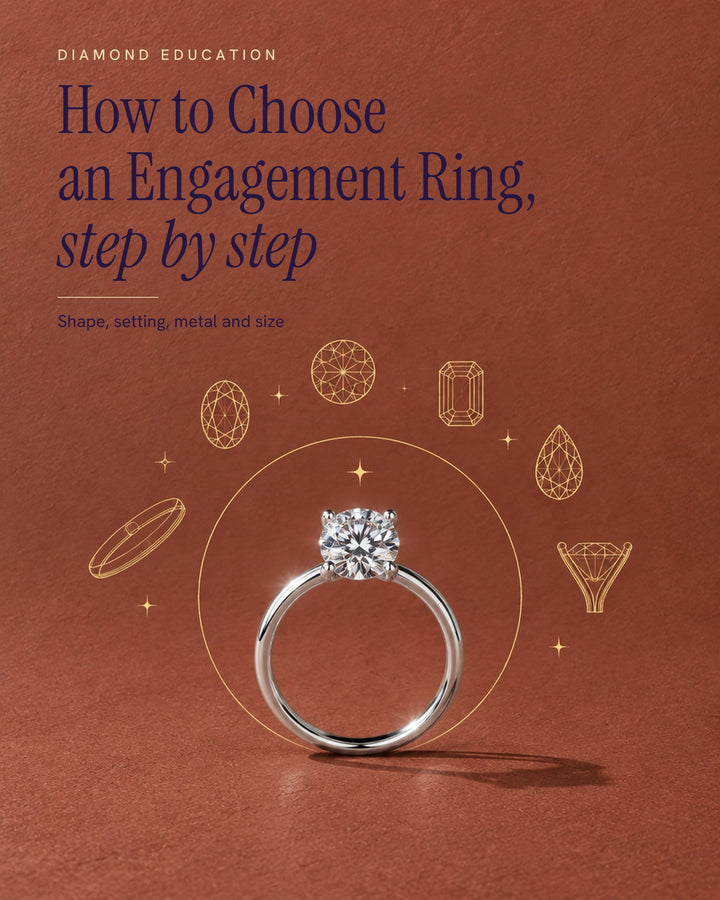
How to Choose an Engagement Ring: The Complete Step-by-Step Guide
Setting, metal, stone and size decided in the order that matters, without guesswork.
Read Article →Lab-Grown vs Natural Diamond Engagement Rings
The same comparison narrowed to the one piece most people are actually choosing between.
Read Article →Ready to shop IGI certified lab grown diamond studs?
Browse our full range from 0.50ct to 4.00ct in 14K gold — every stone IGI certified, every pair lifetime warranted.
Shop Lab Grown Studs → Stud Earrings Guide → FAQ →Shop Lab-Grown Diamonds
Every DEEVE lab-grown diamond is set in solid 14K gold and backed by a lifetime warranty with free shipping across Canada and the USA. Every lab-grown diamond in our engagement rings and diamond stud earrings comes with an IGI certificate. Browse every lab-grown diamond piece, or go straight to: Diamond Rings, Diamond Earrings, Diamond Necklaces, Tennis Bracelets, Diamond Stud Earrings.
Explore expert resources:
Diamond Education Hub → IGI Certificate Explained → Jewelry Care Hub → Warranty & Services → About the Author →About the Author
Written by Arta Talachian, Master Goldsmith & Certified Gemologist. Last updated: August 2026.


0 comments