

Quick Answer: Canadian couples spend an average of $3,500–$5,500 CAD on an engagement ring in 2026. Lab-grown diamond rings start from $800 CAD. Natural diamond rings typically start from $3,000 CAD. Custom bespoke rings start from $3,500 CAD.
Most engagement ring budget guides are written for American couples. The numbers, the retailers, and the benchmarks are all US-based — which makes them nearly useless if you're shopping in Canada.
This is the guide we wish existed when we started: a complete, Canada-specific breakdown of what couples are actually spending, what you get at every price point, and how to make the smartest decision for your budget.
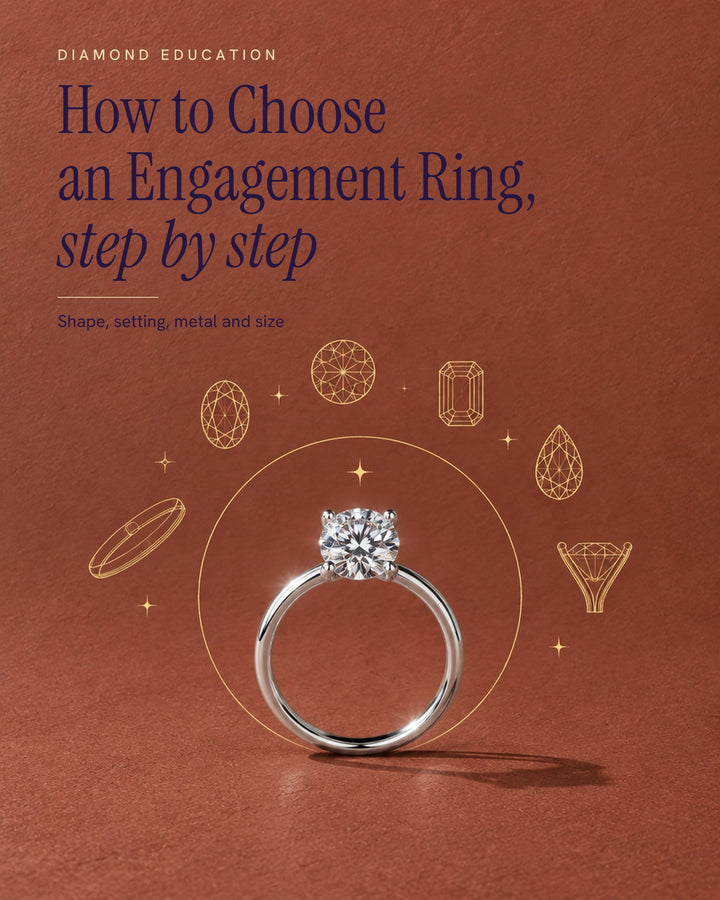
If you are pricing a lab-grown stone, our lab-grown diamond engagement rings are solitaires in 14K gold, in round, oval, cushion, princess, emerald and radiant cuts.
The Canadian Average: What Couples Are Spending in 2026
The average Canadian couple spends between $3,500 and $5,500 CAD on an engagement ring. However, the meaningful range is much wider — from $800 for a beautiful lab-grown solitaire to $25,000+ for a custom natural diamond piece.
Canada vs. USA vs. UK
| Country | Average Spend | Notes |
|---|---|---|
| 🇨🇦 Canada | $3,500–$5,500 CAD | Fastest lab-grown adoption rate |
| 🇺🇸 USA | $5,500–$7,000 USD | Higher cultural spend expectations |
| 🇬🇧 UK | £2,500–£4,000 GBP | Strong preference for classic styles |
The Canadian average is lower than the US for three key reasons: faster adoption of lab-grown diamonds, currency differences, and a cultural shift toward value-conscious luxury.
How the Average Has Changed
| Year | Average (CAD) | Key Driver |
|---|---|---|
| 2020 | $5,800 | Pre-lab-grown mainstream adoption |
| 2022 | $5,200 | Lab-grown begins entering mainstream |
| 2024 | $4,400 | Lab-grown prices drop 40%+ |
| 2026 | $3,500–$5,500 | Lab-grown now majority of new purchases |
 Mentioned in this piece
1.5ct Round Lab Grown Diamond Solitaire Engagement Ring | 14K Gold
$3,143.00
View the piece
Mentioned in this piece
1.5ct Round Lab Grown Diamond Solitaire Engagement Ring | 14K Gold
$3,143.00
View the piece
Cost by Ring Style
The setting style is often the second-biggest cost driver after the stone itself.
| Style | Lab-Grown (CAD) | Natural Diamond (CAD) | Best For |
|---|---|---|---|
| Solitaire | $900–$3,500 | $3,000–$9,000 | Classic, timeless, low maintenance |
| Halo | $1,200–$4,500 | $4,000–$12,000 | Maximum visual impact, appears larger |
| Three-Stone | $1,800–$6,000 | $5,500–$15,000 | Symbolic meaning, anniversary upgrade |
| Pavé Band | $1,500–$5,000 | $4,500–$13,000 | Extra sparkle, modern aesthetic |
| Vintage/Art Deco | $2,000–$7,000 | $6,000–$18,000 | Unique, intricate detail |
| Custom/Bespoke | $3,500–$12,000 | $7,000–$25,000+ | One-of-a-kind, fully personalized |
Solitaire remains the most popular style in Canada — its simplicity keeps labour costs low and puts the focus entirely on the diamond. Halo settings are the fastest-growing style, particularly among couples who want maximum visual impact at a mid-range budget.

For a fully custom design, DEEVE's bespoke studio in Ontario works directly with couples from concept to finished piece.
Lab-Grown vs Natural Diamond: The Real Cost Difference
This is the single most important decision affecting your budget in 2026.
| Stone | 1.00ct Round Solitaire (14K White Gold) | Savings |
|---|---|---|
| Natural Diamond | $6,000–$9,000 CAD | — |
| Lab-Grown Diamond (IGI) | $1,800–$3,200 CAD | Approximately 70% less |
Lab-grown diamonds are not simulants. They are not cubic zirconia or moissanite. They are chemically, physically, and optically identical to mined diamonds — the only difference is origin. A gemologist cannot tell them apart without specialized equipment.
Every lab-grown diamond at DEEVE is certified: IGI for engagement rings and stud earrings, AGI for tennis bracelets and eternity rings. Whether a piece includes its own IGI certificate is recorded per piece and stated on its listing.
Lab-Grown vs Natural: Side-by-Side
| Factor | Lab-Grown | Natural |
|---|---|---|
| Chemical composition | 100% carbon (identical) | 100% carbon |
| Hardness (Mohs) | 10 | 10 |
| Brilliance & fire | Identical | Identical |
| Grading | IGI graded; certificate recorded per piece | Conflict-free and responsibly sourced |
| Ethically sourced | Yes (no mining) | Varies |
| Resale value | Lower | Higher |
| Price per carat | Approximately 70% less | Benchmark |
For most couples buying an engagement ring to wear and cherish — not to resell — lab-grown is the smarter financial decision. Read the full comparison: Lab-Grown vs Natural Diamonds: The Complete Guide
Cost by Diamond Cut
Cut shape significantly affects price. Round brilliants command a premium due to higher demand and more waste during cutting. Fancy shapes offer better value per carat.
| Cut Shape | Price vs Round | Style Notes |
|---|---|---|
| Round Brilliant | Benchmark (highest) | Most popular, maximum brilliance |
| Oval | 10–20% less | Elongates the finger, very trendy |
| Cushion | 15–25% less | Soft corners, romantic feel |
| Princess | 10–20% less | Modern, geometric, sharp corners |
| Emerald | 20–30% less | Art deco, shows clarity clearly |
| Pear | 15–25% less | Unique, elongating, vintage feel |
| Radiant | 15–25% less | Brilliant cut in a rectangular shape |
| Marquise | 20–30% less | Dramatic, elongated, vintage |
Pro tip: Oval and cushion cuts are currently the fastest-growing shapes in Canada — they offer excellent brilliance at a lower price per carat than round, and they visually appear larger face-up.

How Metal Choice Affects Price & Durability
| Metal | Price Premium | Durability | Maintenance |
|---|---|---|---|
| 14K Yellow Gold | Baseline | Excellent (harder alloy) | None required |
| 14K White Gold | +$0–$100 | Excellent | Rhodium re-plate every 1–3 years |
| 14K Rose Gold | +$0–$100 | Excellent | None required |
| 18K Yellow Gold | +$200–$600 | Good (softer, scratches easier) | Occasional polishing |
| 18K White Gold | +$200–$600 | Good | Rhodium re-plate every 1–2 years |
| Platinum | +$800–$2,000 | Very good (develops patina) | Periodic polishing |
For everyday wear, 14K gold is the practical choice — it's harder than 18K (higher alloy content = more scratch-resistant) and significantly less expensive. The colour difference between 14K and 18K is minimal to the naked eye.
Full guide: 14K vs 18K Gold: Which Is Best for Everyday Jewelry?
What You Actually Get at Every Budget Tier
| Budget (CAD) | Stone | Setting | Metal | Best Option |
|---|---|---|---|---|
| Under $1,500 | Lab-grown 0.5–0.75ct, G-H, VS2 | Simple solitaire | 14K gold | Round or oval lab-grown solitaire |
| $1,500–$3,000 | Lab-grown 1.00–1.25ct, G, VS1 | Solitaire or pavé band | 14K gold | IGI-certified oval or cushion |
| $3,000–$5,500 | Lab-grown 1.5–2.5ct, F-G, VVS2 | Halo, three-stone, or custom | 14K or 18K gold | Premium lab-grown or entry natural |
| $5,500–$10,000 | Natural 0.75–1.25ct or lab 2.5ct+ | Any style including bespoke | 18K gold or platinum | Natural solitaire or large lab halo |
| $10,000+ | Natural 1.5ct+, D-F, VVS1 | Fully custom bespoke | 18K gold or platinum | Heirloom-quality custom piece |
Understanding the 4Cs and How They Affect Price
The 4Cs — Cut, Colour, Clarity, and Carat — are the universal grading system for diamonds. Understanding them helps you make smarter trade-offs.
Cut — The Most Important C
Cut determines how much a diamond sparkles. A poorly cut large diamond will look dull next to a well-cut smaller one. Always prioritize Excellent or Very Good cut grades. Never compromise on cut to save money.
Colour — Where You Can Save
The colour scale runs from D (colourless) to Z (yellow tint). For white gold or platinum settings, aim for G–H — they appear colourless to the naked eye but cost significantly less than D–F. For yellow gold settings, you can go as low as I–J since the warm metal masks any tint.
Clarity — Where You Can Save the Most
Most inclusions are invisible to the naked eye below VS2. VS1–VS2 is the sweet spot: eye-clean diamonds at a fraction of the cost of VVS or Flawless grades. SI1 can also be eye-clean — ask to see the stone or certificate before buying.
Carat — The Biggest Price Driver
Carat weight has the most dramatic effect on price. Going from 1.00ct to 1.50ct can double the price. Strategic sizing (0.90ct instead of 1.00ct, 1.45ct instead of 1.50ct) saves 15–20% with no visible difference.
Recommended Sweet Spots for Value
| Budget Goal | Cut | Colour | Clarity | Carat |
|---|---|---|---|---|
| Maximum value | Excellent | G–H | VS2 | 0.90ct |
| Balanced quality | Excellent | F–G | VS1 | 1.00ct |
| Premium look | Excellent | E–F | VVS2 | 1.25ct |
Read more: How to Buy a Lab-Grown Diamond | What Is Diamond Clarity?
How to Get More Ring for Your Budget: 7 Proven Strategies
1. Choose lab-grown
The single biggest lever available. Approximately 70% savings for an identical stone. This is not a compromise — it's a smarter allocation of your budget.
2. Prioritize cut above everything else
A well-cut 0.90ct will outsparkle a poorly cut 1.20ct every time. Never sacrifice cut grade to increase carat weight.
3. Size just below round numbers
0.90ct vs 1.00ct: visually identical, 15–20% less expensive. 1.45ct vs 1.50ct: same visual impact, meaningful savings. This applies at every carat milestone.
4. Choose G–H colour, not D–F
D–F colour commands a significant premium. G–H is visually colourless in a ring setting and saves 20–30% on the stone price.
5. Choose VS2 clarity, not VVS
VS2 is eye-clean in virtually all cases. VVS and Flawless grades are for collectors, not wearers. The premium is not visible.
6. Choose 14K over 18K gold
14K is harder, more durable for daily wear, and less expensive. The colour difference is negligible. For most engagement rings, 14K is the better practical choice.
7. Work with a local Canadian jeweler
Avoid import duties, currency markups, and the risk of buying blind online. A local jeweler lets you see the stone in person and build a relationship for future resizing, cleaning, and repairs.
5 Mistakes to Avoid When Buying an Engagement Ring in Canada
1. Buying from a US retailer without accounting for duties
Import duties, brokerage fees, and currency conversion can add 15–25% to the sticker price. Always calculate the true landed cost before comparing.
2. Prioritizing carat over cut
A bigger but poorly cut diamond looks worse than a smaller, well-cut one. Cut is the most important factor in how a diamond looks in real life.
3. Not knowing what grading you are getting
Ask which grading the piece carries. At DEEVE, lab-grown engagement rings and stud earrings include an individual IGI certificate, while lab-grown eternity bands and tennis bracelets — many small stones, no single centre stone — come with an AGI certificate for the piece as a whole. Natural diamonds are conflict-free and responsibly sourced. A stone with no stated grade at all is the thing to avoid. Learn what an IGI certificate includes.
4. Assuming lab-grown means lower quality
Lab-grown diamonds are graded on the exact same 4C scale as natural diamonds. A lab-grown F/VS1/Excellent is a higher quality stone than a natural H/SI2/Good — regardless of origin.
5. Not considering long-term wearability
Some settings (very thin pavé bands, sharp princess cut corners) are more prone to damage with daily wear. For an everyday ring, prioritize durability in the setting design. How to care for your engagement ring long-term.
Frequently Asked Questions
What is a reasonable budget for an engagement ring in Canada?
A reasonable budget is whatever you can afford without financial stress. The old "three months salary" rule is a marketing myth created by De Beers in the 1980s. In 2026, $1,500–$3,500 CAD buys a beautiful, IGI-certified lab-grown diamond ring in solid 14K gold. There is no minimum.
Is it worth buying a lab-grown diamond engagement ring?
For most couples, yes. Lab-grown diamonds are chemically identical to natural diamonds, certified by the same institutions (IGI, GIA), and cost approximately 70% less. The only meaningful difference is resale value — natural diamonds hold value better. If you're buying a ring to wear and love, not to resell, lab-grown is the smarter financial choice.
Do lab-grown diamonds look different from natural diamonds?
No. A gemologist cannot distinguish a lab-grown from a natural diamond without specialized equipment. To the naked eye — and in photographs — they are identical.
How long does a custom engagement ring take?
A custom bespoke ring typically takes 2–6 weeks depending on design complexity and approvals. If you have a specific date in mind (proposal, anniversary), plan accordingly. Learn about DEEVE's custom process.
Should I buy the ring online or in person?
For certified diamonds (IGI or GIA), buying from a reputable online or local Canadian jeweler is safe — the certificate guarantees the stone's grading. For custom or bespoke work, in-person consultation is strongly recommended. For lab-grown solitaires with a certificate, online is fine if the retailer has a clear return policy.
What finger does an engagement ring go on in Canada?
In Canada, the engagement ring is traditionally worn on the fourth finger of the left hand (the "ring finger"), the same as in the US and UK.
Can I resize an engagement ring later?
Yes, in most cases. Simple solitaire and plain band rings are easiest to resize. Rings with full eternity bands or complex pavé settings are harder (and more expensive) to resize. When in doubt, size slightly larger — it's easier to size down than up.
Ready to Find Your Ring?
Whether you're working with a $1,500 budget or $15,000, the most important thing is finding a ring that reflects your relationship and will last a lifetime.
At DEEVE, every engagement ring is crafted in solid 14K or 18K gold with IGI-certified lab-grown diamonds or natural diamonds, and backed by our lifetime warranty and free shipping across Canada.


0 comments