

Knowing how to clean a tennis bracelet is mostly knowing what not to do to it. A solid 14K gold strand with thirty to a hundred prong settings needs nothing more than warm water, mild dish soap and a soft brush once a month, a soft pouch of its own, and a prong inspection once a year. What damages one is chlorine, household chemicals, ultrasonic cleaners on worn settings, and the slow accumulation of lotion and soap under the stones that turns a bright line dull. This guide covers the cleaning routine step by step, what to avoid and why, how to store the strand, what an inspection looks for, how white and yellow gold age differently, and what the warranty covers.
How to Clean a Tennis Bracelet at Home
The most effective method requires nothing special, and it is the same method a jeweler uses before an inspection.
1. Make the solution. Fill a small bowl with warm water, not hot, and add two or three drops of mild dish soap. Skip anything labeled moisturizing; the additives leave a film.
2. Soak. Lay the bracelet in the bowl for ten to fifteen minutes. The soak loosens skin oil, lotion and residue from the prong settings and from the underside of each mount, where most of the buildup sits.
3. Brush. Use a soft toothbrush, a baby toothbrush is ideal, and work gently around each setting and along the underside of the strand. Brush along the line of the bracelet rather than across it so the bristles do not catch a prong.
4. Rinse. Rinse under warm running water with the drain plugged or a strainer in place. Soap residue is what dulls diamonds, so rinse until the water runs clear from every setting.
5. Dry. Pat dry with a lint-free cloth and let the strand air dry fully before it goes back in its pouch. Water trapped under a stone dries to a spot.
Clean monthly for a strand worn every day, or whenever the line looks less bright than it did. Diamonds attract oil from skin and products, and a film that is invisible on one stone is visible across forty of them.
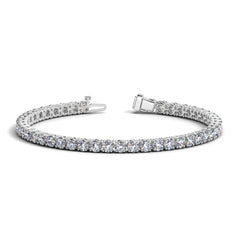 Mentioned in this piece
8 Carat Lab Grown Diamond Tennis Bracelet in 14K White or Yellow Gold
$5,790.00
View the piece
Mentioned in this piece
8 Carat Lab Grown Diamond Tennis Bracelet in 14K White or Yellow Gold
$5,790.00
View the piece
What to Avoid
Chlorine. Pool and hot-tub water attacks the alloying metals in gold over time and weakens prongs. Take the bracelet off before swimming, every time.
Household chemicals. Bleach, acetone and cleaning sprays damage the gold and can etch the surface film on a diamond. Take jewelry off before cleaning.
Ultrasonic cleaners. Effective at removing buildup, but the vibration acts on every prong at once, and a tennis bracelet has more prongs than anything else in a jewelry box. On a setting that has already worn slightly, repeated cycles loosen the grip further. Leave ultrasonic cleaning to a jeweler who has inspected the settings first.
Abrasives. Paper towels, rough cloths, toothpaste and abrasive cleaners scratch gold and dull the polish. A soft cloth and a soft brush are all the strand ever needs.
Sleeping and showering. Neither harms the gold or the stones, but soap and shampoo residue collect in the settings and the strand catches on bedding and towels, which is how prongs are bent. The habit of taking it off at night and putting it on last, after lotion and perfume, is the single change that most extends the time between cleanings.
Storage
Store the bracelet on its own, in a soft pouch or a lined compartment, laid flat rather than coiled. Diamonds are the hardest material there is and will scratch every other piece they touch, and the strand itself will be marked by anything harder than gold that rubs against it. Keep the clasp closed in storage so the two ends cannot tangle with each other, and keep the pouch away from direct sunlight and damp, which do nothing to the diamonds but dull the gold's polish over years.
For travel, the same pouch inside a hard case is enough. Never leave a tennis bracelet loose in a bag; the strand works its way into a knot and the prongs catch on everything.
Annual Prong Inspection
A tennis bracelet carries dozens of independent settings on a piece that swings against desks, door handles and keyboards all day, which is more chances to fail than any other piece in a collection. Prongs wear thin, one setting at a time, and a prong that has worn is a short bench job while a stone that has already gone is a rebuild. Once a year for everyday wear, and more often above about 7 carats where the larger stones put more load on each setting, have the strand inspected: every prong checked for tightness and wear, the clasp and safety catch tested, and any worn prong re-tipped before a stone can move.
Between inspections, a two-minute check at home catches most problems early. Under a bright lamp, run a fingertip along the top of the strand; a raised prong catches the skin. Hold the bracelet to the ear and shake it gently; a loose stone rattles. Open and close the clasp and listen for the click, then test that the safety catch holds when the box clasp is released. Any of the three failing means the strand is set aside until a jeweler has seen it.
White Gold and Yellow Gold Age Differently
White gold carries a rhodium finish, a bright surface layer over the alloy. On a bracelet that finish meets more abrasion than it would on a pendant, so it wears first on the clasp housing and along the outer curve of the strand, and the metal beneath shows as a slightly warmer white. Renewing it is a bench service that does not disturb the settings or the stones. On a DEEVE piece it is covered by the lifetime warranty, so the strand goes back to bright without a charge and without a decision.
Yellow gold has no surface layer to renew. What it develops instead is a patina of fine surface marks that builds with wear and is lifted by polishing. Solid 14K gold does not corrode, and what people read as tarnish on a strand is almost always a film of oil, soap and cosmetics collecting around the settings and under the stones, which the cleaning above reverses. The copper in the alloy can dull very slowly in humid conditions, and the same cleaning reverses that too. Neither metal is more durable than the other; they simply ask for different upkeep.
What the Warranty Covers
Every DEEVE piece carries a lifetime warranty, and the servicing is done in-house. On a tennis bracelet that means the maintenance that keeps a strand alive is covered for the life of the piece: cleaning, inspection, prong retipping and polishing, and the renewal of a white gold rhodium finish. Repair of a manufacturing defect is covered without question. One resize is included free; further resizes are chargeable. The customer ships the piece in on their own carrier and at their own cost, and DEEVE ships it back insured. Details are on the warranty page, and the care section of the complete buying guide sets the same routine beside the rest of the buying decision.
A Care Routine That Takes Five Minutes a Month
Put the strand on last and take it off first. Soak, brush, rinse and dry it once a month. Keep it away from pools, cleaning sprays and abrasives. Store it flat in its own pouch with the clasp closed. Run the fingertip, ear and clasp checks every few weeks, and have it inspected once a year. Done that way, a solid 14K gold strand such as the 8 carat lab-grown diamond tennis bracelet is a piece that outlasts its owner, and every strand in the lab-grown diamond tennis bracelet collection is built the same way. For what to wear it with, see how to style a tennis bracelet.





0 comments