

A diamond tennis bracelet is a single, flexible strand of individually set diamonds arranged in a continuous line around the wrist. It is one of the most enduring designs in fine jewelry, elegant enough for formal occasions and refined enough for everyday wear, and what a tennis bracelet costs comes down to four decisions: total carat weight, which sets the visual presence and most of the price; the grade and matching of the stones; the metal and setting that carry them; and the length. This guide takes each in turn, with the trade-offs a buyer actually faces, and links to a deeper article on every one. Choose by matching total carat weight (2–10 carats) to your wrist size and how you'll wear it, confirm solid 14K gold construction and a secure box clasp, and buy the length that fits rather than the one that is in the box.
Key Takeaways
- A tennis bracelet is a continuous strand of individually set diamonds; the name comes from a 1987 US Open incident involving Chris Evert, not from any connection to the sport itself.
- Lab-grown diamonds are chemically and physically identical to natural diamonds and cost approximately 70% less than natural diamonds of the same size and grade, making higher carat weights more accessible.
- For a multi-stone piece like a tennis bracelet, lab-grown diamonds have a real consistency advantage: CVD production allows precise stone matching across the full strand.
- Tennis bracelet cost is driven by total carat weight first, then by whether the stones are lab-grown or natural, then by the weight of gold in the strand; the grade of the stones matters less than their matching.
- Solid 14K gold is the right metal for daily wear, harder and more wear-resistant than 18K, with equivalent beauty.
- The clasp is the most critical structural component: look for a box clasp with a hidden safety release and test it before purchasing.
- Total carat weight (2–10 carats) determines visual presence; choose based on wrist size, lifestyle, and on stacking or wearing it alone.
What Is a Diamond Tennis Bracelet?
The tennis bracelet is defined by its structure: matched diamonds set in individual mounts, linked together so the bracelet moves fluidly with the wrist. Each stone is typically set in a four-prong mount that maximizes light exposure, creating a continuous line of brilliance that catches light with every movement.
The design is deceptively simple. Its power comes from repetition, the cumulative effect of 30 to 100+ matched diamonds, each contributing to a unified band of light. Getting that effect right requires precise stone matching across color, clarity, and cut, which is why the quality of individual stones matters as much as the total carat weight.
For the full definition, the 1987 origin story, and how to recognize a genuine tennis bracelet design, see our dedicated guide: What Is a Tennis Bracelet?
Lab Grown vs. Natural Diamonds in a Tennis Bracelet
Lab-grown diamonds are chemically, physically, and optically identical to mined diamonds: same hardness, same brilliance, same crystal structure. The only differences are origin, price, and resale value.
For a tennis bracelet specifically, lab-grown diamonds offer a meaningful structural advantage: consistency. A tennis bracelet requires 30 to 100+ matched stones. CVD production allows precise control over growth conditions, resulting in diamonds with predictable and uniform color and clarity grades. Achieving the same consistency with natural diamonds requires extensive parcel selection and typically commands a significant cost premium.
The price difference is substantial. A lab-grown diamond tennis bracelet in solid 14K gold with E–F (colorless) color and VVS2–VS1 (very, very slightly to very slightly included) clarity starts at a fraction of the cost of an equivalent natural diamond bracelet, making higher carat weights genuinely accessible without compromising on quality.
For a full side-by-side comparison, see Lab Grown vs. Natural Diamond Tennis Bracelets and the general primer, Lab-Grown vs Natural Diamonds.
Quality and the 4Cs
Diamond quality is assessed on four criteria: cut, color, clarity, and carat weight. On a solitaire the buyer weighs each of the four for one stone. On a tennis bracelet the same four criteria apply to every stone in the strand, and a fifth consideration sits above them: matching. A single stone a grade off in color or a shade off in cut breaks the continuous line the design depends on, and the eye finds it at once. That is why a well-made strand is judged on consistency across the run before it is judged on the grade of any one diamond.
Cut. Cut decides how much light a stone returns, and on a strand of thirty or more it decides whether the line reads as one unbroken band or a row of individually bright and dull points. DEEVE's lab-grown stones are cut to Excellent, and every stone in a strand is cut to the same standard so the sparkle is even from clasp to clasp.
Color. DEEVE tennis bracelets use E–F (colorless) color. In a line of small stones the difference between D and G is invisible at conversational distance, while the difference between G and K is not; a warm stone next to a white one shows as a break in the line. E–F (colorless) keeps every stone in the strand white, so no single stone reads warm against its neighbors.
Clarity. DEEVE strands use VVS2–VS1 (very, very slightly to very slightly included) clarity. Inclusions at that grade are hard to find even under magnification and are not visible to the eye in a stone of tennis-bracelet size, which is what "eye-clean" means in practice. Each DEEVE bracelet comes with an AGI certificate from the Accredited Gemological Institute that records the color and clarity grades.
Carat weight. Two figures matter. A single stone's weight is written ct; the combined weight of every stone in the strand is written cttw, for carats total weight. A "5 carat tennis bracelet" is five carats spread across the whole strand — and the size of each stone follows from how many stones share that total. The next section is about choosing the total; the grade of the stones is settled by the three criteria above.
For the full framework behind the grades, see our guide to the 4Cs and lab-grown diamond quality.
Choosing the Right Carat Weight
Total carat weight in a tennis bracelet refers to the combined weight of all diamonds across the full strand. It is the single most important factor in determining the bracelet's visual presence on the wrist.
- 2–3 carats: Subtle and refined. Individual stones are small but the continuous line reads clearly. Ideal for everyday wear, layering with other bracelets, or a first fine jewelry purchase.
- 4–5 carats: The most balanced range. Noticeable presence without being overpowering. Works equally well alone or stacked.
- 6–8 carats: Substantial visual impact. Individual stones are clearly visible. A statement piece that commands attention on its own.
- 9–10 carats: Maximum presence. High-visibility, high-brilliance. Best worn as a standalone piece.
Wrist size also matters. A 2 carat bracelet on a larger wrist reads differently than on a smaller one. The goal is a bracelet that sits just above the wrist bone with approximately one finger of space: snug enough to stay in place, loose enough to move freely.
For a full carat-by-carat breakdown with cost and stacking guidance, see our Tennis Bracelet Carat Guide.
What Does a Diamond Tennis Bracelet Cost?
Tennis bracelet cost is set by four things, in this order of weight: the total carat weight of the diamonds, whether those diamonds are lab-grown or natural, the amount of gold in the strand, and the number of settings that have to be made and set. Everything else, brand, packaging and the shop it is bought in, sits on top of those four and is the part a buyer can question.
Carat weight moves the price fastest, and not in a straight line. Doubling the total carat weight more than doubles the price, because larger stones cost more per carat than small ones, and a strand that reaches 8 or 10 carats with the same stone count has to use larger stones. Two strands of the same carat weight can therefore differ in price: one built from many small stones, one from fewer larger ones. The stone count is printed on a good listing for exactly that reason.
Lab-grown against natural is the second lever. The same strand, same grades, same gold, costs a fraction in lab-grown diamonds of what it costs in mined ones, and the gap widens as the carat weight rises, because large natural stones are rare and large lab-grown stones are not. This is why a 10 carat natural tennis bracelet is a jeweler's showcase piece and a 10 carat lab-grown one is a purchase an ordinary buyer can make.
The gold is the third. A tennis bracelet carries a surprising amount of metal, every mount, every hinge and the clasp, and a strand in solid 14K gold is priced partly by its gram weight. A listing that states the weight is telling you what you are paying for; one that does not is asking you to take the metal on trust. Hollow or plated strands are lighter and cheaper, and they are cheaper because there is less gold in them.
Labor is the fourth. Each stone is set by hand into its own mount, and a strand of forty stones is forty settings, forty prong checks and a clasp that has to hold all of it. Setting cost scales with the count, which is one more reason two strands of equal carat weight can be priced apart.
What this means for a buyer asking how much a diamond tennis bracelet is: decide the carat weight first, because it moves the price most and changes the look most; take lab-grown, because the saving is largest exactly where the bracelet gets impressive; then compare listings on gram weight and stone count, not on adjectives. DEEVE's range runs from 2 to 10 carats in solid 14K gold, and each product page shows its price in your currency, its gram weight and its stone grades, so the comparison above can be made line by line before buying. Start with the lab-grown diamond tennis bracelet collection.
Yellow Gold vs. White Gold
Both yellow and white gold tennis bracelets are set in solid 14K gold, the optimal karat for daily wear. At 140–200 HV Vickers hardness, 14K gold resists scratching and wear far better than 18K or 24K, making it the right choice for a piece worn on the wrist every day.
On a tennis bracelet the metal does more visible work than it does on a ring. A solitaire shows one setting; a line strand shows a continuous run of them, so the gold is a structural element the eye reads along the whole length of the piece. That is why this choice lands differently here than it does on a pendant or a stud.
14K White Gold
White gold creates a seamless, icy look: the metal recedes and the diamonds appear to float. It suits the E–F (colorless) stones DEEVE sets and gives maximum contrast against the skin.
White gold carries a rhodium finish, which is a surface layer over the alloy rather than the alloy itself. On a bracelet that finish meets more abrasion than it would on a pendant: a wrist rests against desks, tables and keyboards all day, so wear shows first on the clasp housing and along the outer curve of the strand. Renewing it is a bench operation DEEVE performs in-house under the lifetime warranty, and it does not disturb the settings or the stones.
14K Yellow Gold
Yellow gold provides warmth and contrast. The diamonds read against a rich gold background, and the tone is more forgiving of slight variation between stones.
Yellow gold has no surface layer to renew. What it develops instead is a patina of fine surface marks that builds with wear and is lifted by polishing rather than re-plating. For a wearer who would rather not carry a maintenance step, that is the practical difference between the two metals.
Which to Choose
Neither is more durable than the other. Both are solid 14K gold with equivalent hardness and wear resistance, both take the same four-prong settings, and both close with the same box clasp and hidden safety catch. The decision is usually what the strand will sit next to. A tennis bracelet shares a wrist with a watch and often with other pieces, so the metal that matches what is already worn is the answer more often than not. Match the existing stack first; the aesthetic argument only decides it when there is nothing to match.
Setting Style and Clasp
Four-Prong Setting
The four-prong setting is the standard for tennis bracelets because it exposes the maximum surface area of each diamond, allowing light to enter and exit from multiple angles. Each stone sits in its own individual mount, held by four fine prongs that grip the girdle of the diamond. The result is maximum brilliance with minimal metal visible between stones.
Bezel and Channel Alternatives
Two other constructions appear on tennis bracelets, and each trades light for protection. A bezel setting wraps a thin rim of gold around each stone: the girdle is covered, the stone cannot catch on a sleeve, and the strand reads as a run of small gold circles with a diamond in each. It is the most secure setting and the least brilliant, because the rim blocks light from the side. A channel setting holds a row of stones between two continuous rails of gold with no prongs at all; it gives a sleek, flat line and protects the stones well, but it shows the least of each diamond and is the hardest to repair if a stone is lost, since the rails must be reopened. Prongs remain the choice for a bracelet bought for its light; bezels and channels are the choice for a wearer whose hands work hard and who would rather have security than sparkle.
Clasp and Security
The clasp is the most structurally critical component of a tennis bracelet: it is the point most likely to fail, and failure means losing the bracelet entirely. A well-made tennis bracelet uses a box clasp with a hidden safety release: the box clasp provides a secure mechanical lock, and the safety release adds a secondary catch that prevents accidental opening.
When evaluating a tennis bracelet, test the clasp before purchasing. It should open with deliberate pressure and close with a firm, audible click. A clasp that opens too easily or feels loose is a structural concern regardless of the quality of the diamonds. Worn on the wrist, the clasp should sit on the underside where it meets the least contact, and it is the first part to show wear on a white gold strand, so it is the part to look at first at each inspection.
How to Size a Tennis Bracelet
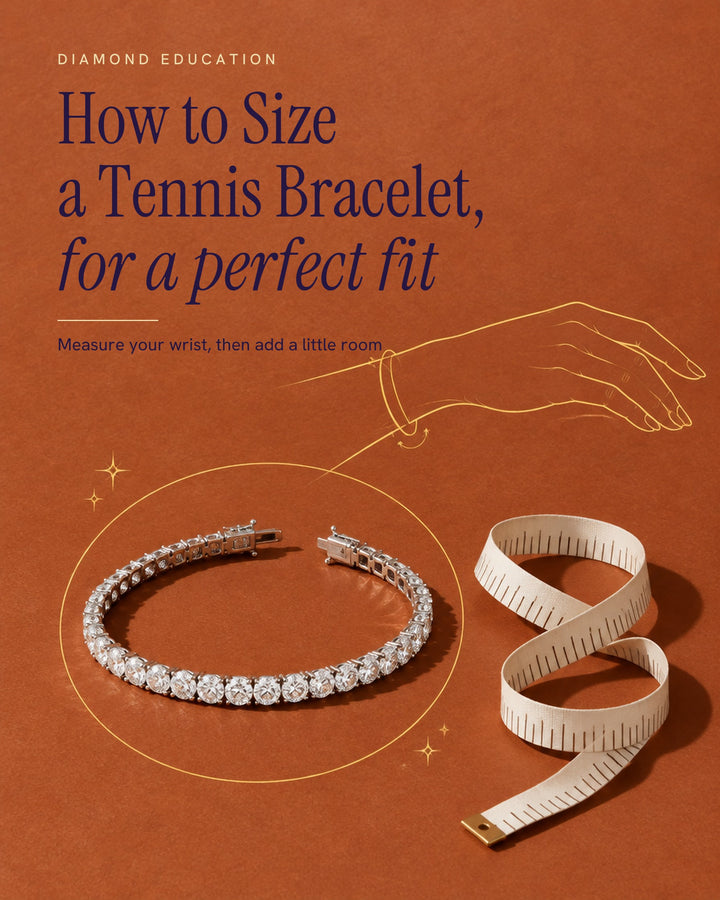
Measure your wrist with a soft tape measure or a strip of paper, held snug but not tight just above the wrist bone. Add roughly 1.5–2 cm to that measurement for the ideal bracelet length: enough for the strand to rotate freely without sliding over the hand. If you are between sizes, size up. A bracelet that is slightly loose is more comfortable and easier to clasp than one that is too tight.
A tennis bracelet is fixed in length, with no adjustable chain, so the length has to be right when it is bought. DEEVE's strands are stocked at 7 inches, which suits most wrists, and a different length can be fitted to order; ask before buying rather than after, because a fitted strand is made for that wrist. For a full walkthrough with a sizing chart, see How to Size a Tennis Bracelet.
How to Wear and Care for a Tennis Bracelet
A tennis bracelet set in solid 14K gold is durable enough for daily wear. Remove it before swimming in chlorinated water, heavy lifting, or contact with household chemicals. Clean regularly with warm water, mild soap, and a soft brush. Have the clasp and prongs inspected by a jeweler every 12–18 months.
Wearing Tips
- Wear the clasp on the underside of the wrist for comfort and aesthetics
- Allow one finger of space between the bracelet and your wrist
- Stack with simple chain bracelets or a watch, and keep the metal family consistent. See How to Style a Tennis Bracelet for full pairing guidance.
- Remove before high-impact activities, swimming, or chemical exposure
For the full cleaning routine, what to avoid, and warranty details, see Tennis Bracelet Care & Maintenance.
Shop Diamond Tennis Bracelets
DEEVE's diamond tennis bracelets range from 2 to 10 carats, set in solid 14K yellow or white gold, with a lifetime warranty and free worldwide shipping. Shop the full collection →
Comparing several bracelets before you choose? Our guide to the best lab-grown diamond tennis bracelet sets out seven checks to run on any listing, from the grade band to the clasp.
About the Author
Written by Arta Talachian, Master Goldsmith & Certified Gemologist. Last updated: September 2026.



0 comments