

Written by Arta Talachian, Master Goldsmith & Certified Gemologist | Last updated: July 2026
Quick Answer
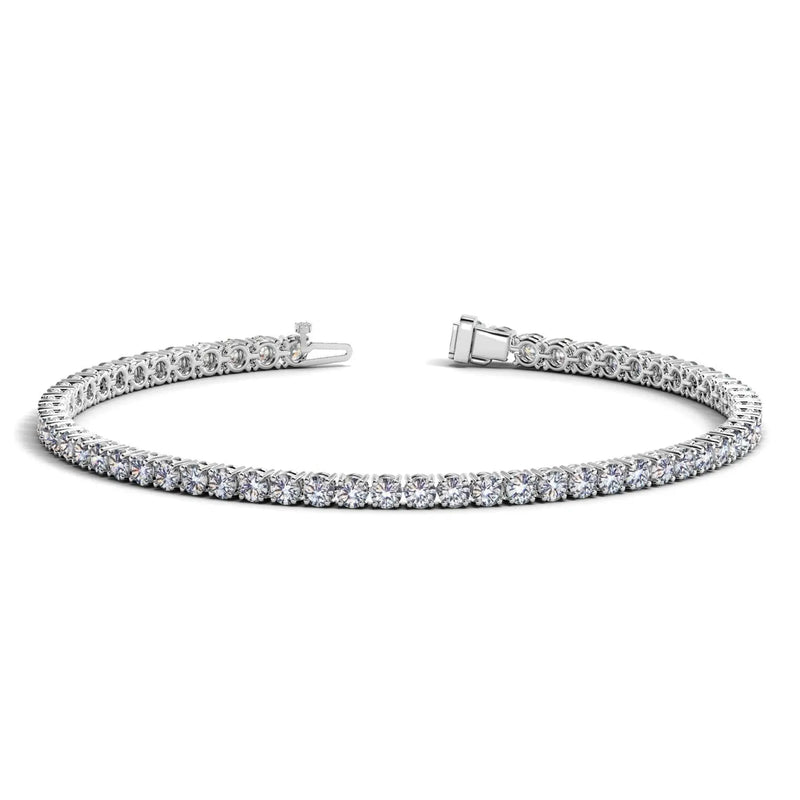
A tennis bracelet is a single, flexible strand of individually set diamonds arranged in a continuous line around the wrist, each stone held in its own prong mount. It gets its name from a 1987 US Open match, when tennis player Chris Evert's diamond line bracelet broke and fell onto the court during play.
Key Takeaways
- A tennis bracelet is defined by structure — matched diamonds set individually, linked into a continuous flexible strand — not by a single style or era.
- The name is a 1987 accident, not a design term: before Chris Evert's US Open moment, the style was called a diamond line bracelet or eternity bracelet.
- Fit is fixed-length (typically 17 cm or 19 cm), not adjustable like a slider bracelet.
- The design is unisex; carat weight and width are what change the read, not the underlying structure.
The Definition
A tennis bracelet is defined by its structure, not by a specific era or trend: matched diamonds, each set in its own individual mount, linked together so the bracelet moves fluidly with the wrist. Most mounts use a four-prong setting that exposes the maximum surface area of each stone, so light enters and exits from multiple angles across the entire strand rather than from one central stone.
The effect comes from repetition. A single large diamond draws the eye to one point; a tennis bracelet's 30 to 100+ matched stones create a continuous line of brilliance instead. That's why stone-to-stone consistency in colour, clarity, and cut matters as much as total carat weight — any mismatch breaks the unified line.
Why It's Called a "Tennis" Bracelet
The name has nothing to do with the design and everything to do with a single moment. In 1987, professional tennis player Chris Evert stopped a US Open match to look for her diamond line bracelet after the clasp gave way and it fell onto the court. The moment was broadcast live, and the press and jewellers alike began calling the style a "tennis bracelet" almost immediately afterward. Before 1987, the identical design was sold as a diamond line bracelet or an eternity bracelet — the structure didn't change, only the name.
How to Recognize One
- Continuous line, not a focal stone — no single diamond dominates; the strand itself is the design.
- Individual prong settings — each stone sits in its own mount, usually four-prong, rather than being channel- or bezel-set as a block.
- Flexible, articulated strand — the bracelet drapes and moves with the wrist rather than sitting rigid.
- Fixed length with a clasp — typically 17 cm or 19 cm, closed with a box clasp, rather than an adjustable chain or slider.
Fit Is Fixed, Not Adjustable
Unlike a slider or chain bracelet, a tennis bracelet is made to a specific length and isn't adjusted after the fact — getting the right fit means choosing the correct length before buying, not resizing afterward. See our sizing guide for how to measure.
Who Wears a Tennis Bracelet
The design itself is unisex — the structure of matched, linked diamonds doesn't inherently skew toward one gender. It has historically been marketed toward women, but thinner widths and lower carat weights are increasingly worn by men as a minimal, everyday piece rather than a statement one.
Further Reading
- The Complete Buying Guide for Diamond Tennis Bracelets — full buying guide
- Lab Grown vs. Natural Diamond Tennis Bracelets — how the stones compare
- Tennis Bracelet Carat Guide — choosing carat weight
- Shop the 4ct Tennis Bracelet
- Shop Lab Grown Diamond Tennis Bracelets — 2ct to 10ct



0 comments