
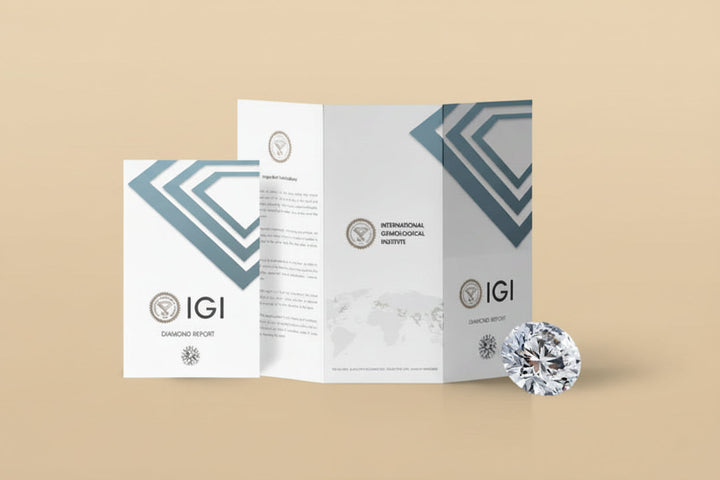
For lab-grown diamonds, IGI is the recommended certificate. IGI grades more lab-grown diamonds than any other laboratory, has developed specific protocols for CVD and HPHT stones, and its reports cost less — meaning you get the same certified quality without inflating the diamond price. GIA is equally reputable but grades fewer lab-grown stones and carries a cost premium that is not justified for most buyers. Both labs use the same 4Cs framework. Always buy certified — from either lab.
Part of our complete lab-grown diamond guide.
On This Page
Quick Answer Full Comparison Grading Philosophy Grade Variance How to Verify Gemologist's Verdict FAQQuick Answer
- IGI = industry standard for lab-grown diamonds — highest volume, lab-grown-specific protocols, lower report cost
- GIA = global standard for natural diamonds — equally reputable, fewer lab-grown reports, higher cost
- Both use the 4Cs — cut, color, clarity, carat — established by GIA in 1953
- IGI grades slightly more generously on color and clarity for lab-grown — a known variance, not a defect
- Always verify your certificate — IGI at report.igi.org, GIA at gia.edu/report-check
- Never buy uncertified — no certificate means no independent verification of what you're buying
IGI vs GIA: Full Comparison for Lab-Grown Diamonds
| Factor | IGI | GIA |
|---|---|---|
| Founded | 1975, Antwerp | 1931, New York |
| Lab-grown grading since | 2005 (earliest major lab) | 2020 |
| Lab-grown volume | Highest globally | Significantly lower |
| Lab-grown protocols | CVD/HPHT-specific | Same as natural |
| 4Cs grading (lab-grown) | Yes — full 4Cs letter grades | Premium/Standard classification since 2025 |
| Growth method disclosure | Yes — CVD or HPHT noted | Yes — noted on report |
| Post-growth treatment disclosure | Yes — explicitly noted | Yes — noted on report |
| Laser inscription | Yes — report number on girdle | Yes — report number on girdle |
| Online verification | report.igi.org | gia.edu/report-check |
| Report cost (to trade) | Lower | Higher |
| Grading stringency (lab-grown) | Slightly more lenient | Slightly stricter |
| Industry recognition (lab-grown) | Dominant standard | Highly respected |
| Industry recognition (natural) | Respected | Global gold standard |
| DEEVE grading | IGI — all lab-grown diamonds | — |
Grading Philosophy: How IGI and GIA Approach Lab-Grown Diamonds Differently
GIA built its reputation grading natural diamonds over 90+ years. Its 4Cs framework — introduced in 1953 — is the universal language of diamond quality. When GIA entered lab-grown grading in 2020, it applied the same rigorous standards it uses for natural stones. In 2025 GIA moved its lab-grown reports to a simplified Premium/Standard classification rather than specific 4Cs letter grades. This is a strength: consistency and conservatism. It is also why GIA reports for lab-grown diamonds carry a premium — the same infrastructure, the same standards, applied to a stone that costs a fraction of its natural equivalent.
IGI has been grading lab-grown diamonds since 2005 — 15 years before GIA entered the market. That volume of experience has produced lab-grown-specific grading protocols that account for the unique inclusion types found in CVD diamonds (planar defects, silicon inclusions) and HPHT diamonds (metallic flux inclusions). IGI reports explicitly note the growth method (CVD or HPHT) and any post-growth treatments, giving buyers more lab-grown-specific information than a standard GIA report.
Conservative, consistent grading. Global brand recognition. Same standards as natural diamonds — useful if resale or cross-comparison matters to you.
15+ years of lab-grown-specific experience. CVD/HPHT protocols. Lower report cost. Dominant industry standard — most lab-grown diamonds sold globally carry IGI certification.
The Grade Variance Question: Is IGI Grading Inflated?
This is the most common concern buyers raise, and it deserves a direct answer. Industry data and gemologist experience consistently show that IGI grades lab-grown diamonds approximately one sub-grade more generously than GIA on color and clarity — meaning a stone graded VS1 G by IGI might grade VS2 H at GIA.
This is a known, documented variance — not fraud, not a defect. It reflects different calibration standards between two reputable laboratories. Note that this letter-grade comparison applies to GIA lab-grown reports issued before 2025; since GIA moved to Premium/Standard classification, a direct sub-grade comparison is no longer possible on current GIA lab-grown reports. Where both reports carry letter grades, an IGI VS1 G is not necessarily equivalent to a GIA VS1 G.
The more important point: both labs are internally consistent. An IGI VS1 G today will grade the same as an IGI VS1 G tomorrow. The grade is reliable within the lab's own standards. Buy by the certified grade from a reputable lab — and understand which lab issued the certificate.
"The grade variance between IGI and GIA is real and well-documented in the trade. It does not make IGI certificates unreliable — it makes them different. I review IGI certificates daily. The grading is consistent and the reports are detailed. For lab-grown diamonds, IGI gives you more information about the stone's growth method and treatment history than a standard GIA report. That matters."
— Arta Talachian, Master Goldsmith & Certified Gemologist, DEEVE — Full bio →How to Verify Your Certificate
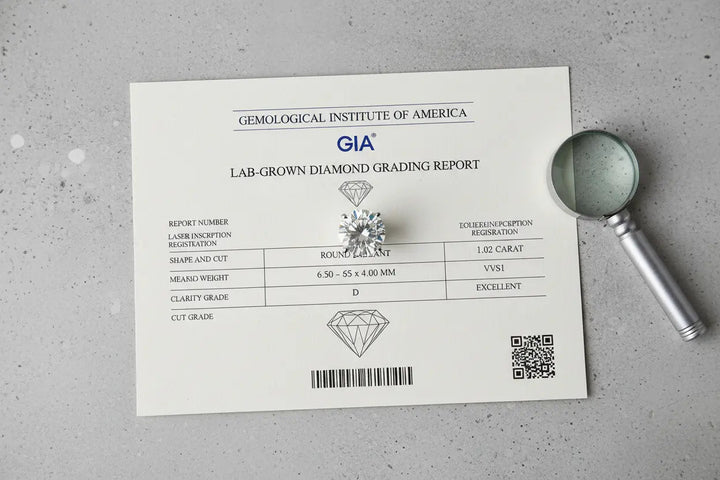
Every legitimate IGI or GIA certificate can be verified online in under 60 seconds. This is non-negotiable — always verify before purchase.
IGI verification: Go to report.igi.org and enter the report number. The online record should match every field on your physical or digital certificate exactly.
GIA verification: Go to gia.edu/report-check and enter the report number.
Laser inscription check: The report number is laser-inscribed on the diamond's girdle (the narrow band around the widest point). Under 10× magnification, this inscription should match the report number exactly. Any discrepancy is a red flag.
For a full walkthrough of how to read an IGI certificate field by field, see: What Is an IGI Certificate? →
Gemologist's Verdict
For lab-grown diamonds: choose IGI. Not because GIA is inferior — GIA is the most respected gemological institution in the world — but because IGI is the dominant standard for lab-grown diamonds, has 15+ years of lab-grown-specific experience, and its reports provide more growth-method detail at a lower cost.
If you are buying a high-value natural diamond where resale matters, GIA is the right choice. For lab-grown diamonds at any price point, IGI is the industry standard and the practical choice.
The most important rule applies to both: never buy an uncertified diamond. The certificate — from either lab — is your only independent verification of what you are purchasing.
Frequently Asked Questions
Q: Is IGI or GIA better for lab-grown diamonds?
A: IGI is the industry standard for lab-grown diamonds — highest volume, lab-grown-specific protocols, lower report cost. GIA is equally reputable but grades fewer lab-grown stones and carries a cost premium. For most lab-grown buyers, IGI is the practical choice.
Q: Are IGI and GIA grading standards the same?
A: Both use the 4Cs framework. On GIA lab-grown reports issued before 2025, IGI graded approximately one sub-grade more generously than GIA on color and clarity — a known industry variance. Since 2025 GIA reports lab-grown diamonds as Premium or Standard rather than letter grades, so IGI is the only one of the two still giving full 4Cs grades for lab-grown stones.
Q: Does GIA certify lab-grown diamonds?
A: Yes — GIA has issued lab-grown diamond reports since 2020. Since 2025 those reports use a simplified Premium/Standard classification rather than full 4Cs letter grades, which makes stone-to-stone comparison harder than with IGI. GIA grades significantly fewer lab-grown diamonds than IGI, and reports carry a higher cost.
Q: Why does DEEVE use IGI certification?
A: IGI is the most widely recognized certification for lab-grown diamonds globally. It has the largest volume of lab-grown grading experience, specific protocols for CVD and HPHT stones, and provides detailed, verifiable reports without inflating the diamond price unnecessarily.
Q: How do I verify an IGI or GIA certificate is real?
A: Verify IGI at report.igi.org and GIA at gia.edu/report-check using the report number. The laser inscription on the diamond's girdle must match the report number exactly. Always verify before purchase.
Q: Is an uncertified lab-grown diamond worth buying?
A: No. Never buy an uncertified diamond. Without a certificate from IGI, GIA, or GCAL, you have no independent verification of cut, color, clarity, or carat weight. The certificate is your only protection against misrepresentation.


0 comments