
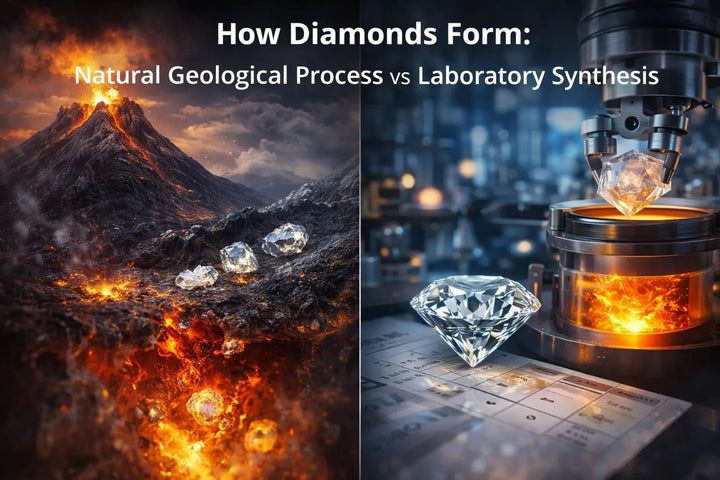
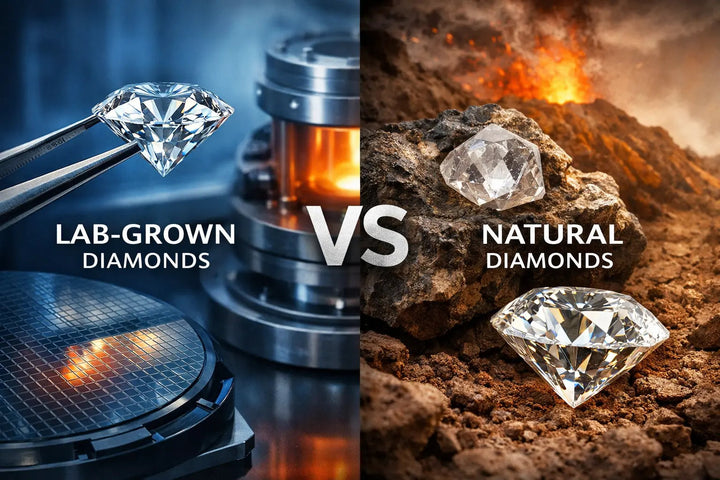
A lab grown diamond is a real diamond — not a simulant, not a fake. It has the same chemical composition (pure carbon), the same crystal structure, the same hardness (10 Mohs), and the same optical brilliance as a mined diamond. The only difference is where it formed: underground over billions of years, or in a laboratory over a few weeks. Both are graded by IGI using the same 4Cs system.
Quick Answer
- Real diamond — same carbon crystal structure, same hardness (10 Mohs), same refractive index as mined diamonds
- Two growth methods: CVD (Chemical Vapor Deposition) and HPHT (High Pressure High Temperature) — both produce genuine diamond
- IGI certified — graded on the same 4Cs (cut, color, clarity, carat) as natural diamonds
- Approximately 70% less expensive than equivalent natural diamonds — same quality, lower cost of production
- Ethically sourced — no mining, no conflict supply chains, fully traceable origin
- Cannot be distinguished visually — even trained gemologists need specialized equipment to tell them apart
Lab Grown vs Natural Diamond: Key Differences
Chemical composition: Pure carbon (C)
Crystal structure: Cubic (diamond cubic)
Hardness: 10 Mohs
Refractive index: 2.417
Origin: Laboratory (CVD or HPHT)
Certification: IGI, GIA, HRD
Price: approximately 70% less than natural
Ethics: No mining required
Chemical composition: Pure carbon (C)
Crystal structure: Cubic (diamond cubic)
Hardness: 10 Mohs
Refractive index: 2.417
Origin: Earth's mantle (1–3 billion years)
Certification: GIA, IGI, HRD
Price: Market rate
Ethics: Varies by source
For a full scientific comparison, see Lab-Grown vs Natural Diamonds: Are They Really the Same? →
How Lab Grown Diamonds Are Made
A diamond seed is placed in a vacuum chamber filled with carbon-rich gas (methane). Microwave energy breaks down the gas, depositing carbon atoms layer by layer onto the seed. Growth takes 2–4 weeks. Produces high-purity, gem-quality diamonds. Most common method for jewelry-grade lab diamonds.
Replicates the conditions of the Earth's mantle: pressures of 5–6 GPa and temperatures of 1,300–1,600°C. A carbon source melts around a diamond seed and crystallizes into diamond. Faster than CVD. Often used to improve color in existing diamonds. Produces slightly different growth patterns detectable only by spectroscopy.
Full technical comparison: CVD vs HPHT Lab Diamonds: What’s the Difference and Which Is Better? →
How Lab Grown Diamonds Are Graded
Lab grown diamonds are graded using the same 4Cs system as natural diamonds, by the same gemological laboratories:
Determines brilliance and light performance. Grades: Excellent, Very Good, Good, Fair, Poor. Cut is the most important factor for visual beauty.
Graded D (colorless) to Z (light yellow). D–F = colorless. G–J = near-colorless (best value). Most DEEVE lab diamonds are G–H color.
Graded FL (flawless) to I3 (included). VS1–VS2 = very slightly included (eye-clean). SI1 may be eye-clean depending on inclusion placement.
Every lab-grown diamond in our engagement rings and diamond stud earrings comes with an IGI certificate. For a full guide to reading your certificate, see What Is an IGI Lab Grown Diamond Certificate — and How Do You Read One? →
Are Lab Grown Diamonds Worth It?
For quality and value: Yes. A lab grown diamond at the same cut, color, and clarity grade as a natural diamond costs approximately 70% less. That budget difference can go toward a larger carat weight, a better color grade, or a higher-quality setting.
For ethics: Yes. Lab grown diamonds require no mining, eliminating concerns about environmental disruption and conflict supply chains. Origin is fully traceable.
For resale: No — if resale value is your priority. Lab grown diamond prices have declined as production scales. Natural diamonds also depreciate from retail, but less dramatically. Neither is a reliable financial investment.
For a full buyer’s guide, see The Complete Lab-Grown Diamond Guide: Everything You Need to Know Before You Buy →
Common Misconceptions About Lab Grown Diamonds
“Lab grown diamonds are fake.” False. Simulants like cubic zirconia and moissanite are not diamonds — they have different chemical compositions. Lab grown diamonds are chemically and physically identical to natural diamonds.
“You can tell them apart by looking.” False. Even expert gemologists cannot visually distinguish lab grown from natural diamonds. Specialized spectroscopy equipment is required.
“Lab grown diamonds aren’t as hard or durable.” False. Both score 10 on the Mohs scale — the maximum. Lab grown diamonds are just as suitable for daily wear as natural diamonds. See How Durable Are Diamonds? →
“Lab grown diamonds aren’t certified.” False. IGI, GIA, and HRD all certify lab grown diamonds using the same grading standards as natural diamonds. For a full myth-busting guide, see Lab-Grown Diamond Myths Debunked →
Explore related expert resources from Arta Talachian:
Complete Lab Diamond Guide → Diamond FAQ Hub → About the Author →Want the full technical breakdown? Continue below for a detailed scientific analysis covering diamond crystal structure, CVD and HPHT growth mechanisms, spectroscopic detection methods, and 4Cs grading science — authored by Arta Talachian, Master Goldsmith & Certified Gemologist.
Expert Breakdown: Lab Grown Diamond Science, Growth & Grading
Diamond Crystal Structure and Chemical Composition
Carbon in the Diamond Cubic Structure
Diamond is pure carbon (element C, atomic number 6) arranged in a diamond cubic crystal structure — a face-centered cubic lattice with additional atoms at tetrahedral positions. Each carbon atom forms four covalent bonds with neighboring carbon atoms in a tetrahedral arrangement, creating an exceptionally strong three-dimensional network.
This bonding structure is responsible for diamond’s extraordinary properties: hardness of 10 Mohs (the maximum on the scale), thermal conductivity higher than any other material at room temperature, and optical transparency across a wide wavelength range. Lab grown diamonds have this identical crystal structure — there is no chemical or structural difference from natural diamonds.
Type Classification: Type Ia, Ib, IIa, IIb
Diamonds are classified by nitrogen content and distribution. Type Ia (most natural diamonds): nitrogen in aggregated clusters, causes slight yellow tint. Type Ib (rare natural, common HPHT lab): isolated nitrogen atoms, stronger yellow. Type IIa (rare natural, common CVD lab): no nitrogen, colorless to near-colorless, highest optical purity. Type IIb: boron present, blue color.
Most CVD lab grown diamonds are Type IIa — the same classification as the world’s most prized natural diamonds (Cullinan, Koh-i-Noor). This is not a marketing claim; it reflects the growth conditions of CVD, which produces low-nitrogen diamonds by default. For more on Type IIa diamonds, see What Is a Type IIa Diamond? The Purest Diamond Explained →
CVD Growth Process in Detail
Seed Preparation and Chamber Setup
CVD growth begins with a diamond seed — a thin slice of existing diamond (natural or lab grown) approximately 3–5mm square. The seed is placed on a substrate inside a vacuum chamber. The chamber is evacuated and filled with a mixture of hydrogen gas (H₂, ~95%) and methane (CH₄, ~5%) at pressures of 10–300 torr.
Plasma Activation and Carbon Deposition
Microwave energy (2.45 GHz) or hot filaments ionize the gas mixture, creating a plasma — a high-energy state where molecules dissociate into reactive species. Atomic hydrogen (H•) plays a critical role: it etches non-diamond carbon (graphite) preferentially, ensuring only diamond carbon bonds form on the growing surface.
Carbon atoms from dissociated methane deposit onto the seed surface, bonding in the diamond cubic arrangement. Growth proceeds layer by layer at rates of 0.1–0.3 mm per day. A 1-carat rough diamond requires approximately 2–4 weeks of continuous growth.
Post-Growth Processing
After growth, the rough CVD diamond is removed from the chamber. It may undergo HPHT treatment to improve color (removing brown tints caused by vacancy defects). The rough is then cut and polished using identical techniques to natural diamonds — laser cutting, bruting, faceting, and final polishing on diamond-impregnated wheels.
HPHT Growth Process in Detail
Replicating Earth’s Mantle Conditions
HPHT growth replicates the geological conditions under which natural diamonds form: pressures of 5–6 GPa (equivalent to 50,000–60,000 atmospheres) and temperatures of 1,300–1,600°C. These conditions are achieved using belt presses, cubic presses, or split-sphere (BARS) apparatus.
Carbon Source and Crystallization
A carbon source (graphite or diamond powder) is placed with a diamond seed and a metal catalyst (iron, nickel, or cobalt) in the press. Under extreme pressure and temperature, the metal catalyst melts and dissolves the carbon source. Carbon migrates through the molten metal and crystallizes onto the cooler diamond seed, growing outward in the characteristic octahedral pattern of natural diamonds.
Growth Rate and Crystal Characteristics
HPHT growth is faster than CVD — a 1-carat rough can be produced in days rather than weeks. HPHT diamonds often show cuboctahedral growth sectors and may contain metallic inclusions from the catalyst. These inclusions are detectable by spectroscopy and are one method used to identify HPHT-grown diamonds. For a full comparison of CVD vs HPHT characteristics, see CVD vs HPHT Lab Diamonds: What’s the Difference? →
Detection and Identification
Why Visual Inspection Fails
Lab grown and natural diamonds are visually identical under standard gemological examination. A loupe (10x magnification) or microscope reveals inclusions and growth features, but these do not reliably distinguish origin — both lab and natural diamonds can be flawless or included. Standard refractometers, thermal conductivity testers, and UV lamps cannot distinguish them.
Spectroscopic Detection Methods
Specialized equipment can identify lab grown diamonds through photoluminescence (PL) spectroscopy, which detects characteristic emission lines from nitrogen-vacancy centers and other defects specific to CVD or HPHT growth. DiamondView (De Beers) uses short-wave UV fluorescence to reveal growth patterns — CVD diamonds show layered growth striations; HPHT diamonds show cuboctahedral sector patterns. These patterns are invisible to the naked eye and require laboratory-grade equipment.
IGI Certification for Lab Grown Diamonds
The 4Cs Applied to Lab Grown Diamonds
IGI grades lab grown diamonds using the same 4Cs methodology as natural diamonds. Cut grades (Excellent through Poor) assess proportions, symmetry, and polish. Color grades (D–Z) measure nitrogen-related body color. Clarity grades (FL–I3) assess inclusions and blemishes under 10x magnification. Carat weight is measured to the nearest 0.01 carat on precision scales.
IGI certificates for lab grown diamonds are clearly marked “Lab Grown” and include the growth method (CVD or HPHT). The certificate number is laser-inscribed on the diamond’s girdle for verification. For a complete guide to reading your IGI certificate, see What Is an IGI Lab Grown Diamond Certificate — and How Do You Read One? →
IGI vs GIA vs HRD for Lab Grown Diamonds
IGI is the most widely used laboratory for lab grown diamond certification, with the largest volume of lab grown grading globally. GIA began certifying lab grown diamonds in 2020 and uses the same D–Z color scale. HRD (Antwerp) is the leading European laboratory. All three use equivalent grading standards. For a comparison of certificate reliability, see GIA vs IGI vs GCAL: Which Diamond Certificate Should You Trust? →
Lab Grown Diamond Property Summary
| Property | Lab Grown Diamond | Natural Diamond | Moissanite | Cubic Zirconia |
|---|---|---|---|---|
| Chemical Composition | Pure carbon (C) | Pure carbon (C) | Silicon carbide (SiC) | Zirconium dioxide (ZrO₂) |
| Hardness (Mohs) | 10 | 10 | 9.25 | 8–8.5 |
| Refractive Index | 2.417 | 2.417 | 2.65–2.69 | 2.15–2.18 |
| IGI Certified | ✅ Yes | ✅ Yes | ❌ No | ❌ No |
| Real Diamond | ✅ Yes | ✅ Yes | ❌ No (simulant) | ❌ No (simulant) |
| Price vs Natural | Approximately 70% less | Market rate | ~90% less | ~95% less |
Related Articles
- The Complete Lab-Grown Diamond Guide: Everything You Need to Know Before You Buy
- Lab-Grown vs Natural Diamonds: Are They Really the Same?
- CVD vs HPHT Lab Diamonds: What’s the Difference and Which Is Better?
- Lab-Grown Diamond Myths Debunked: What’s True, What’s Marketing?
- What Is an IGI Lab Grown Diamond Certificate — and How Do You Read One?
- GIA vs IGI vs GCAL: Which Diamond Certificate Should You Trust?
- How Durable Are Diamonds? Hardness, Toughness & Long-Term Wear Explained
- What Is a Type IIa Diamond? The Purest Diamond Explained
- Diamond FAQ Hub — All Questions Answered
This guide was authored by Arta Talachian, Master Goldsmith & Certified Gemologist with 25+ years of experience in fine jewelry design, crafting, and appraisal. For more expert resources, visit the Complete Lab-Grown Diamond Guide or the Diamond FAQ Hub.
Shop IGI Certified Lab Grown Diamonds
Every DEEVE lab grown diamond is ethically sourced and set in solid 14K gold. Every lab-grown diamond in our engagement rings and diamond stud earrings comes with an IGI certificate. Free shipping and lifetime warranty included.


0 comments