

14K gold is 58.5% pure gold — the remaining 41.5% is copper, silver, and zinc, added to make the metal hard enough for daily wear. It is the most widely used gold standard in North American fine jewelry because it balances gold content, durability, and cost better than any other karat. 14K gold is DEEVE's standard for everyday fine jewelry.
Quick Answer
- 14K = 58.5% pure gold — stamped as "14K", "585", or "14ct" on the piece
- Hardness: 140–200 HV — 5–6x harder than pure 24K gold (25–30 HV)
- Most durable karat for daily wear — rings, bracelets, chains all benefit from 14K's higher alloy content
- Available in yellow, white, and rose gold — same gold content, different alloying metals determine color
- Does not tarnish like silver or brass — but copper in the alloy can cause green skin staining in acidic skin types
- Less expensive than 18K — lower gold content = lower material cost, not lower quality
Part of the DEEVE Complete Guide to Gold Jewelry — this article expands the section on Gold Purity: Karats Explained.
14K vs 18K vs 24K: At a Glance
58.5% gold. Hardness: 140–200 HV. Best scratch resistance. Most durable for rings, bracelets, chains. Lower cost. Slight green skin risk for acidic skin types.
75% gold. Hardness: 125–165 HV. Richer yellow color. Softer than 14K. Better for sensitive skin (less copper). Higher cost. Preferred for heirloom pieces.
99.9% gold. Hardness: 25–30 HV. Too soft for daily wear. Scratches easily, prongs bend, rings deform. Suitable only for ceremonial or collector pieces.
For the full materials science comparison, see 14K vs 18K vs 24K Gold: Durability, Wear Resistance & Longevity Compared →
 Mentioned in this piece
Round Cable Link Chain Necklace in 14K Gold | 2.40mm
$1,787.00
View the piece
Mentioned in this piece
Round Cable Link Chain Necklace in 14K Gold | 2.40mm
$1,787.00
View the piece
What Is 14K Gold Made Of?
The exact composition varies by color and manufacturer, but a typical 14K yellow gold contains:
58.5% gold (Au)
20% copper (Cu)
20% silver (Ag)
1.5% zinc (Zn)
Copper adds hardness and warmth. Silver balances color toward classic yellow. Zinc deoxidizes during casting.
58.5% gold (Au)
~25% palladium (Pd)
Balance: silver/zinc
Palladium whitens the alloy and keeps it nickel-free. Most white gold is rhodium-plated for a brighter white finish.
58.5% gold (Au)
28–30% copper (Cu)
Balance: silver
Higher copper content creates the distinctive pink hue. No plating required. Slightly harder than yellow gold.
58.5% gold (Au)
~17% nickel (Ni)
Balance: copper/zinc
Lower cost than palladium-white. Harder (160–200 HV). Causes allergic reactions in 10–20% of people — avoid if nickel-sensitive.
For a deep dive into how each alloying metal affects color and strength, see Gold Alloy Composition: How It Affects Strength, Color & Wear →
How to Identify 14K Gold: Hallmarks
Genuine 14K gold is stamped with one of these hallmarks, typically found on the inside of rings, on clasps, or on earring posts:
Standard North American marking. Most common on Canadian and US jewelry.
European standard — represents 58.5% gold content. Common on imported pieces.
UK and Commonwealth countries. "ct" = carat (same as karat in North America).
Is 14K Gold Good for Daily Wear?
Yes — 14K is the optimal karat for daily-wear jewelry. Its higher alloy content (41.5%) gives it hardness of 140–200 HV, making it significantly more resistant to scratching and deformation than 18K or 24K gold.
For pieces that take the most abuse — rings, bracelets, and chains — 14K outperforms 18K in scratch resistance and prong retention. The trade-off is slightly less gold content and a marginally less rich yellow color.
For the full analysis of how gold wears over time by karat, see How Gold Jewelry Wears Over Time: Karat, Abrasion & Maintenance →
Does 14K Gold Tarnish or Turn Skin Green?
Tarnish: Solid 14K gold does not tarnish the way silver or brass does. The high gold content (58.5%) protects the surface. However, the copper and silver in the alloy can slowly oxidize in humid or sulfur-rich environments, creating a subtle dulling over time — easily reversed with mild soap and warm water.
Green skin: 14K yellow and rose gold contain ~20–30% copper. In people with acidic skin pH (below 5.5), copper can react with sweat to form green copper salts that transfer to skin. This is harmless and washes off — but if it's a recurring issue, switching to 18K (less copper) or palladium-white gold typically eliminates it.
Full explanation: Why Gold Jewelry Turns Skin Green: Sweat, pH & Skin Chemistry →
14K Gold Care: What You Need to Know
Daily cleaning: Rinse with warm water after heavy sweating or exposure to lotions and perfumes.
Weekly cleaning: Mild dish soap + warm water + soft brush. Rinse thoroughly and dry completely before storing.
Remove before: Swimming in chlorinated pools or the ocean, heavy exercise, applying cosmetics or perfume.
Storage: Store in a low-humidity environment, separately from other metals to prevent galvanic corrosion. Never store damp.
Explore related expert resources from Arta Talachian:
Gold Alloy Composition → 14K vs 18K vs 24K → Gold Education Hub → Gold FAQ → About the Author →Want the full technical breakdown? Continue below for a detailed metallurgical analysis of 14K gold's crystal structure, solid solution strengthening, phase behavior, and comparative mechanical properties — authored by Arta Talachian, Master Goldsmith & Certified Gemologist.
Expert Breakdown: What Is 14K Gold — Metallurgy, Properties & Performance
Gold Purity Standards and the Karat System
How the Karat System Works
The karat system divides gold purity into 24 parts. Pure gold is 24 karats (24K) — 99.9% gold by weight. Each karat represents 1/24th of the total composition. 14K gold therefore contains 14/24 = 58.33% gold. The remaining 41.67% consists of alloying metals selected to achieve specific mechanical, optical, and chemical properties.
The "585" hallmark used in European markets represents this gold content as a decimal fraction: 585 parts per thousand = 58.5% gold (rounded from 58.33%). Both 14K and 585 refer to the same alloy standard.
Why 14K Became the North American Standard
14K gold emerged as the dominant standard in North American jewelry for several practical reasons. It provides sufficient gold content to maintain the appearance and prestige of gold jewelry while delivering the mechanical properties needed for daily-wear durability. The higher alloy content (41.5%) compared to 18K (25%) translates directly to greater hardness, scratch resistance, and structural integrity — critical for rings and bracelets that experience constant abrasion.
Cost is also a factor: 14K contains less gold per gram than 18K, making it more accessible without compromising on quality. In contrast, European markets historically favored 18K, reflecting different cultural preferences for gold richness over durability.
Mechanical Properties of 14K Gold
Hardness and Yield Strength
14K gold alloys achieve Vickers hardness of 140–200 HV depending on alloy composition and heat treatment. This compares favorably to 18K (125–165 HV) and dramatically outperforms pure 24K gold (25–30 HV). The yield strength of 14K alloys ranges from 220–320 MPa — meaning the metal can withstand 4–6 times more stress than pure gold before permanent deformation occurs.
These properties translate directly to practical durability: 14K prongs hold gemstones more securely, 14K ring shanks resist oval deformation, and 14K chain links withstand tension without stretching. For a full comparison of mechanical properties across karats, see 14K vs 18K vs 24K Gold: A Materials Science Comparison.
Solid Solution Strengthening
The hardness of 14K gold results primarily from solid solution strengthening. When copper, silver, and zinc atoms dissolve into gold's face-centered cubic (FCC) crystal lattice, they create local distortions due to atomic size mismatch. Copper atoms (128 pm) are smaller than gold atoms (144 pm), creating compressive strain fields that impede dislocation movement — the primary mechanism of plastic deformation.
The higher concentration of alloying atoms in 14K (41.5%) versus 18K (25%) creates more lattice distortions and greater resistance to dislocation movement, explaining 14K's superior hardness. For a detailed explanation of how each alloying element contributes, see Gold Alloy Composition: Strength, Color & Wear Properties.
Scratch and Abrasion Resistance
Scratch resistance correlates directly with hardness. At 140–200 HV, 14K gold resists scratching from most everyday materials. Common substances that can still scratch 14K gold include hardened steel tools (>200 HV), ceramic surfaces (~800 HV), and diamond (~10,000 HV). Sand (quartz, ~800 HV) will scratch 14K gold — a key reason to remove jewelry before beach activities.
Abrasive wear — the gradual removal of metal through repeated contact with harder surfaces — occurs more slowly in 14K than in 18K or 24K gold. Over decades of daily wear, 14K rings lose less mass and maintain their dimensions better than higher-karat equivalents. For a full analysis of long-term wear behavior, see How Gold Jewelry Wears Over Time: Karat, Abrasion & Maintenance.
14K Gold Color Variations
Yellow Gold: Copper-Silver Balance
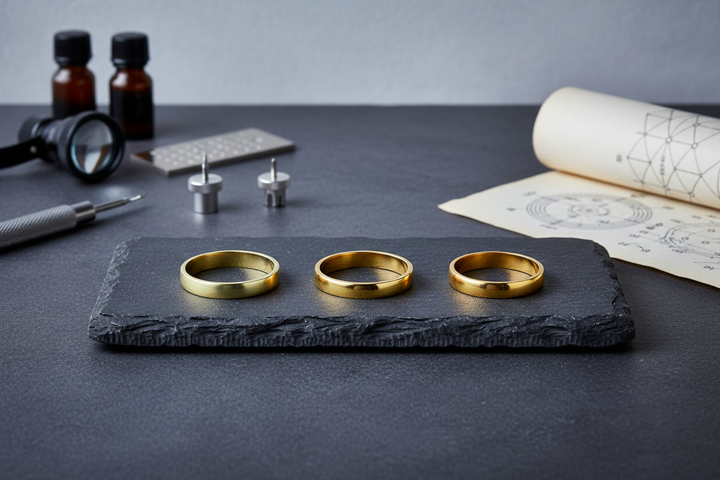
14K yellow gold achieves its color through a balanced copper-silver ratio. A typical formulation (58.5% Au, 20% Cu, 20% Ag, 1.5% Zn) produces classic warm yellow. Increasing copper toward 25% creates warmer, reddish-yellow tones; increasing silver toward 25% produces cooler, greener yellows. The color is permanent throughout the metal — no plating required.
White Gold: Palladium vs Nickel
14K white gold suppresses gold's natural yellow through substantial additions of whitening metals. Palladium-based 14K white gold (58.5% Au, ~25% Pd, balance Ag/Zn) is nickel-free and corrosion-resistant but more expensive. Nickel-based 14K white gold (58.5% Au, ~17% Ni, balance Cu/Zn) is harder (160–200 HV) and less expensive but causes allergic reactions in 10–20% of people.
Both are typically rhodium-plated (0.1–0.25 microns) for a bright white finish. The plating wears through friction every 1–3 years and requires professional re-application. For guidance on choosing between palladium and nickel white gold, see White Gold vs Yellow Gold vs Rose Gold: What's the Difference?
Rose Gold: Copper-Dominant
14K rose gold contains the highest copper percentage of any 14K alloy — typically 28–30% Cu — creating a rich, deep pink color. This high copper content also makes 14K rose gold the hardest of the three colors (145–165 HV) but increases susceptibility to green skin staining in acidic skin types and subtle patina development over time.
Tarnish and Corrosion Behavior
Why 14K Gold Resists Tarnish
Gold is chemically inert — it does not react with oxygen, sulfur, or most acids under normal conditions. At 58.5% gold content, 14K alloys retain substantial tarnish resistance. The gold-rich surface layer (gold enrichment occurs naturally as more reactive metals oxidize preferentially) provides ongoing protection.
However, the copper and silver in 14K alloys are reactive. Copper oxidizes to form copper oxides and sulfides; silver forms silver sulfide (tarnish) when exposed to sulfur compounds. In practice, these reactions are slow and surface-limited — regular cleaning prevents visible accumulation. For the full electrochemical explanation, see Does Solid Gold Tarnish? A Chemical Explanation.
Green Skin Staining: Mechanism and Prevention
Green skin staining from 14K gold results from copper corrosion. When copper in the alloy contacts acidic sweat (pH below 5.5) and chloride ions, it forms soluble copper salts (verdigris) that transfer to skin. The reaction is accelerated by high sweat chloride concentration, acidic skin pH, and moisture.
Prevention strategies include switching to 18K (less copper), choosing palladium-white gold (minimal copper), removing jewelry before heavy exercise, and cleaning regularly to remove accumulated salts. For the complete guide to skin chemistry and gold, see Why Gold Jewelry Turns Skin Green: Sweat, pH & Skin Chemistry.
14K Gold Property Summary
| Property | 14K Yellow | 14K White (Pd) | 14K Rose |
|---|---|---|---|
| Gold Content | 58.5% | 58.5% | 58.5% |
| Hardness (HV) | 140–160 | 150–200 | 145–165 |
| Tarnish Risk | Low | Very Low | Moderate |
| Plating Required | No | Rhodium (1–3 yrs) | No |
| Nickel-free | Yes | Yes (palladium-based) | Yes |
| Green Skin Risk | Moderate | Low | Higher |
Related Articles
- Gold Alloy Composition: How It Affects Strength, Color & Wear
- 14K vs 18K vs 24K Gold: Durability, Wear Resistance & Longevity Compared
- Why Pure Gold (24K) Isn't Used in Everyday Jewelry
- White Gold vs Yellow Gold vs Rose Gold: What's the Difference?
- Why Gold Jewelry Turns Skin Green: Sweat, pH & Skin Chemistry
- How Gold Jewelry Wears Over Time: Karat, Abrasion & Maintenance
- Gold Education Hub — All Guides
- Gold Jewelry FAQ — Complete Guide
This guide was authored by Arta Talachian, Master Goldsmith & Certified Gemologist with 25+ years of experience in fine jewelry design, crafting, and appraisal. For more expert resources, visit the Gold Education Hub or Gold Jewelry FAQ.
Shop Solid 14K Gold
DEEVE works in solid gold — properly alloyed, never plated, never filled — with 14K as our standard. Available in yellow, white, and rose gold with a lifetime warranty and free shipping.



0 comments