

Pure gold is too soft to wear — so it's always mixed with other metals to create an alloy. The metals added (copper, silver, palladium, nickel, zinc) determine the jewelry's color, hardness, tarnish resistance, and skin compatibility. Understanding alloy composition is the key to choosing the right gold for your lifestyle, skin type, and budget.
Quick Answer
- Copper makes gold harder and pinker — more copper = rose gold; less = yellow gold
- Silver softens the color toward cooler, greener yellows and preserves ductility
- Palladium creates white gold that is nickel-free and highly corrosion-resistant
- Nickel creates white gold at lower cost but causes allergic reactions in 10–20% of people
- 14K gold is harder than 18K because it contains more alloying metals (41.5% vs 25%)
- White gold is not naturally white — it's rhodium-plated to achieve a bright white finish
Part of the DEEVE Complete Guide to Gold Jewelry — this article expands the section on Gold Alloys: Colour, Composition & Chemistry.
If you are choosing a piece now, our gold bracelets include styles in 14K yellow, white and rose gold, such as the diamond-cut rope bracelet in 14K rose gold, so the alloy you settle on here is one you can wear.
What Each Alloying Metal Does
Increases hardness significantly. Shifts color toward pink/red. Creates rose gold at high concentrations. More reactive — can tarnish and cause green skin staining in acidic skin types.
Moderate hardening. Shifts color toward cooler, greener yellows. Preserves ductility. Can tarnish via silver sulfide when exposed to sulfur compounds.
Creates white gold. Nickel-free. Excellent corrosion resistance. More expensive than nickel. Best choice for sensitive skin.
Creates white gold at lower cost. Strong hardening effect. Causes allergic reactions in 10–20% of people. Restricted in EU jewelry regulations.
Used in small amounts (1–5%). Deoxidizes during casting, refines grain structure, lowers melting point. Excessive zinc causes brittleness.
Premium white gold alloys. Hypoallergenic, excellent corrosion resistance. Significantly higher cost than palladium or nickel alternatives.
 Mentioned in this piece
Rib Link Bracelet in 14K Yellow Gold
$3,437.00
View the piece
Mentioned in this piece
Rib Link Bracelet in 14K Yellow Gold
$3,437.00
View the piece
Gold Color by Alloy Composition
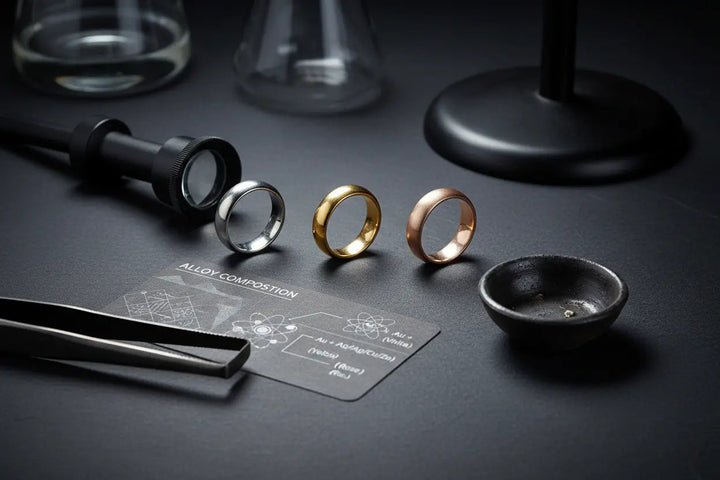
Balanced copper + silver. 18K: ~75% Au, 12.5% Cu, 12.5% Ag. More copper = warmer/redder. More silver = cooler/greener. No plating required.
Copper-dominant. 18K: ~75% Au, 20% Cu, 5% Ag. 14K: ~58.5% Au, 28–30% Cu. Deeper pink with more copper. No plating required.
Palladium or nickel-based. Naturally gray/yellow — rhodium-plated for bright white finish. Plating wears off every 1–3 years and needs re-application.
Which Alloy Is Right for You?
Sensitive skin / nickel allergy: Choose palladium-white gold, yellow gold (18K+), or rose gold. Avoid nickel-white gold.
Green skin staining: Switch from 14K to 18K (less copper), or from rose gold to white/yellow gold. See our skin chemistry guide for the full explanation.
Maximum durability for daily wear: 14K yellow or white gold — highest alloy content = hardest, most scratch-resistant — shop our solid 14K gold bangles →

Lowest maintenance: Yellow gold (no plating). Rose gold (no plating, develops natural patina). White gold requires rhodium re-plating every 1–3 years.
Heirloom / investment: 18K yellow or palladium-white gold — higher gold content, excellent corrosion resistance, proven multi-generational track record.
Alloy Composition & Property Quick Reference
| Alloy Type | Typical Composition | Hardness (HV) | Tarnish Risk | Skin Safe? |
|---|---|---|---|---|
| Yellow 18K | 75% Au, 12.5% Ag, 12.5% Cu | 125–140 | Low | ✅ Yes |
| Rose 18K | 75% Au, 20% Cu, 5% Ag | 135–150 | Moderate | ✅ Yes (nickel-free) |
| White 18K (Pd) | 75% Au, 15% Pd, 10% Ag | 150–165 | Very Low | ✅ Yes (nickel-free) |
| White 18K (Ni) | 75% Au, 15% Ni, 10% Cu/Zn | 160–180 | Low | ⚠️ Not for nickel-sensitive |
| Yellow 14K | 58.5% Au, 20% Cu, 20% Ag, 1.5% Zn | 140–160 | Moderate | ✅ Yes |
| White 14K | 58.5% Au, 25% Ni/Pd, balance Cu/Zn | 150–200 | Low | ⚠️ Depends on Ni vs Pd |
Explore related expert resources from Arta Talachian:
Gold Education Hub → Jewelry Care Hub → Skin & Gold Chemistry → About the Author →Want the full technical breakdown? Continue below for a detailed metallurgical analysis covering solid solution strengthening, grain boundary effects, phase diagrams, corrosion mechanisms, and mechanical property trade-offs — authored by Arta Talachian, Master Goldsmith & Certified Gemologist.
Expert Breakdown: Gold Alloy Composition — Strength, Color & Wear Properties
Fundamentals of Gold Alloys
Solid Solution Strengthening Mechanisms
When alloying elements dissolve into gold's crystal lattice, they create a solid solution — a homogeneous mixture at the atomic level. Alloying atoms differ in size from gold atoms, creating local lattice distortions that impede dislocation movement, the primary mechanism of plastic deformation in metals.
The strengthening effect depends on atomic size mismatch, concentration, and modulus difference. Copper, silver, and zinc all provide solid solution strengthening in gold, though to varying degrees based on their atomic radii and solubility limits. To understand how these differences translate to everyday durability, see our 14K vs 18K vs 24K Gold: A Materials Science Comparison.
Grain Boundary Effects
Polycrystalline metals consist of many small crystals (grains) separated by grain boundaries — regions of atomic mismatch. Grain boundaries impede dislocation movement, contributing to strength through the Hall-Petch relationship: smaller grains produce stronger materials. Alloying elements can refine grain structure during solidification and heat treatment, further strengthening these regions.
Phase Diagrams and Microstructure
Binary phase diagrams map the phases present in two-element systems as functions of composition and temperature. The gold-copper system shows complete solid solubility at high temperatures but forms ordered intermetallic compounds (AuCu and AuCu₃) at lower temperatures. Jewelry alloys are typically designed to remain in the disordered solid solution state at room temperature, balancing strength with workability.
Common Alloying Elements and Their Functions
Copper: Hardness and Reddish Hue
Copper is the most common alloying element in gold jewelry. Copper atoms (128 pm) are smaller than gold atoms (144 pm), creating significant lattice strain that hardens the alloy. It also shifts gold toward warmer, pinker tones — rose gold contains 20–25% copper in 18K formulations. The primary drawback is copper's reactivity: it oxidizes more readily than gold, contributing to tarnish in high-copper alloys. For a full analysis of tarnish behavior, see Gold Tarnish Resistance: Electrochemistry, Alloy Oxidation & Surface Science.
Silver: Whitening and Ductility
Silver's atomic radius (144 pm) closely matches gold's, causing less lattice distortion than copper and preserving ductility. Its white color counteracts gold's yellow, producing greener or paler yellow tones. Yellow gold alloys typically balance copper and silver to achieve desired color while optimizing mechanical properties.
Zinc: Deoxidation and Color Modulation
Zinc appears in small quantities (typically 1–5%) for deoxidation during casting, color adjustment, melting point reduction, and grain refinement. Excessive zinc (>5%) can cause brittleness and increased oxidation susceptibility.
Palladium and Nickel: White Gold Formation
Creating white gold requires substantial whitening power. Palladium (10–20% in 18K white gold) provides excellent whitening, a nickel-free alloy, and superior corrosion resistance. Nickel (10–17% in 18K white gold) offers strong whitening and significant hardening at lower cost, but causes allergic reactions in 10–20% of the population. Most white gold is rhodium-plated to achieve a bright white finish.
Platinum Group Metals: Premium White Alloys
Some premium white gold formulations use platinum, ruthenium, or iridium as whitening agents, creating hypoallergenic alloys with excellent corrosion resistance at significantly higher cost than nickel-based alternatives.
Color Formation in Gold Alloys
Yellow Gold: Balanced Cu-Ag Ratios
Classic yellow gold maintains gold's natural hue while adding strength. An 18K yellow gold might contain 75% Au, 12.5% Cu, and 12.5% Ag. More copper creates warmer, reddish yellows; more silver produces cooler, greener yellows.
Rose/Pink Gold: Copper-Dominant Alloys
Rose gold's distinctive pink color comes from high copper content. An 18K rose gold typically contains 75% Au, 20% Cu, and 5% Ag. The intensity of pink correlates with copper percentage — 22.5% copper produces deep rose, while 15% creates subtle pink tones.
White Gold: Palladium, Nickel, or Platinum Additions
White gold alloys suppress gold's yellow through substantial additions of white metals. Palladium-white gold appears slightly warm gray; nickel-white gold shows cooler, steelier tones. Rhodium plating (0.1–0.25 microns) provides a uniform bright white finish but wears over time, requiring periodic replating. For a buyer-friendly comparison of all three gold colors, see White Gold vs Yellow Gold vs Rose Gold: Which Is Easiest to Care For?

Green and Gray Gold: Specialty Compositions
Green gold (electrum) contains high silver content (20–30% in 18K), creating greenish-yellow tones. Gray gold incorporates iron, palladium, or manganese for neutral gray colors. These specialty alloys are less common but offer distinctive aesthetics.
Mechanical Property Trade-Offs
Hardness vs. Workability
A 14K alloy (41.5% alloying metals) is harder than 18K (25% alloying metals) but more difficult to form, requiring greater force for fabrication and showing reduced ability to be reshaped without cracking.
Strength vs. Ductility
The strength-ductility trade-off is fundamental to alloy design. Higher strength allows thinner, lighter designs but reduces the material's ability to absorb impact energy. Jewelry alloys are optimized for balanced properties rather than maximum strength.
Wear Resistance vs. Polishability
Harder alloys resist scratching but are more difficult to polish to a high luster. Softer alloys polish easily but scratch more readily. This trade-off influences maintenance requirements — harder alloys retain finish longer but require more aggressive polishing when refinishing is needed.
Corrosion and Tarnish Behavior by Alloy Type
Copper-Rich Alloys and Oxidation
Rose gold and copper-heavy yellow gold alloys develop patina over time as copper oxidizes. This creates a warm, aged appearance valued in vintage jewelry. The oxidation is surface-limited and reversible through polishing.
Nickel Sensitivity and Skin Reactions
Nickel is a common allergen, causing contact dermatitis in sensitive individuals. EU regulations restrict nickel in jewelry; palladium-white gold offers a nickel-free alternative.
Palladium's Corrosion Resistance
Palladium-based white gold exhibits excellent corrosion resistance, superior to nickel or copper-containing alloys. It resists tarnish, oxidation, and chemical attack, making it ideal for individuals with sensitive skin or those in corrosive environments.
Related Articles
- What Is 14K Gold? Purity, Composition & Why It's the Standard for Fine Jewelry
- 14K vs 18K vs 24K Gold: Which Is Best for Everyday Jewelry?
- Why Pure Gold (24K) Isn't Used in Everyday Jewelry
- Does Solid Gold Tarnish? A Chemical Explanation
- Why Gold Jewelry Turns Skin Green: Sweat, pH & Skin Chemistry
- How Gold Jewelry Wears Over Time: Karat, Abrasion & Maintenance
- White Gold vs Yellow Gold vs Rose Gold: Which Is Easiest to Care For?
- Gold Education Hub — All Guides
- Gold Jewelry FAQ — Complete Guide
- Gold Care FAQ
This guide was authored by Arta Talachian, Master Goldsmith & Certified Gemologist with 25+ years of experience in fine jewelry design, crafting, and appraisal. For more expert resources, visit the Gold Education Hub or Jewelry Care Guide Hub.
Shop by metal type
Find Your Gold — Yellow, White & Rose
Every DEEVE piece is solid 14K gold in the alloy of your choice — yellow, white, or rose. Never plated. Lifetime warranty and free shipping to Canada and the US.



0 comments